Topic guide
Facades and Exterior Design
The facade is the part of a building that has to do the most jobs at once — keep water out, manage heat and vapour, carry its own weight and wind load, survive decades of weather, and look deliberate while doing it. This guide covers how facade systems differ, what actually drives material selection, and how to combine materials without the result reading as arbitrary.
A facade is a system, not a surface
The most common mistake in facade decisions is choosing a material and assuming the system will follow. It works the other way around. The system — how water is managed, how the cladding is supported, how the assembly dries — determines which materials are viable, how they must be detailed, and how long they will last.
Start with types of facade systems to compare full wall arrangements before shortlisting panels. For glazed enclosures, compare curtain wall and window wall at the slab edge to locate support, movement and drainage interfaces.
The distinction that matters most
Direct application describes attachment; face-sealed and drained describe rain-control strategies. WBDG’s Moisture Movement guidance distinguishes face-sealed EIFS from drained walls. A bonded finish can also have a water barrier and drainage details behind it.
| Stated arrangement | What to check |
|---|---|
| Traditional face-sealed EIFS | Finish, joints and openings form the rain-control plane |
| Water-managed bonded finish | Confirm water barrier, drainage route and exits |
| Ventilated panel rainscreen | Confirm backing water barrier, cavity, airflow openings and flashing |
Weight, depth, cost and drying need the actual layers, permeability and junction details; this table does not rank them. For the exposure assessment, use climate-responsive facade strategies.
What actually drives material selection
Use these as an editorial screening sequence, not a statistical ranking:
- Exposure and climate — driving rain, UV, freeze-thaw cycling, salt.
- Substrate and structure — what the wall can carry, especially in renovation.
- Fire requirements — which for facades is frequently a hard constraint rather than a preference, and varies sharply by jurisdiction and building height.
- Maintenance appetite — who will recoat, reseal or replace, and how often.
- Weight — confirm full assembly load and fixing capacity.
- Appearance — colour, texture, module, how it weathers.
Appearance is last on this list and first in most conversations. That inversion is the source of a lot of expensive redesign.
Combining materials
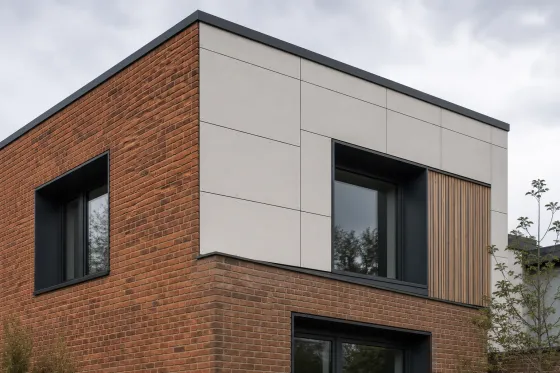
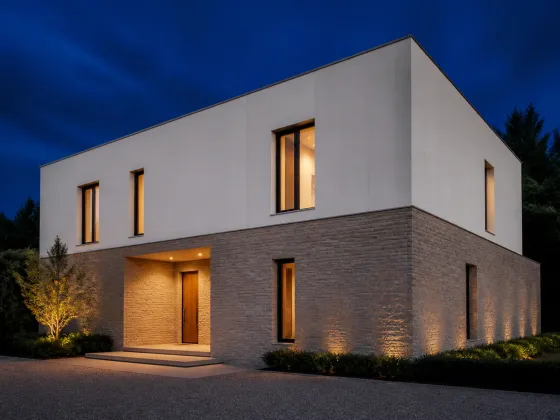
Facades that read as considered usually follow one of a few rules: one dominant material with an accent of a second; materials separated by a clear horizontal or vertical line rather than blended; or a change of material at a change of building form. The failure mode is the “material patchwork” — three or four cladding types applied in similar quantities with no logic to where each one stops.
Every junction between two materials is also a detailing problem — differential movement, different fixing depths, a water path. Review every transition; fewer materials do not themselves prove better performance. Use combining facade materials to organise the visual and junction decisions.
Next, compare the stated assemblies in ventilated vs direct-applied cladding. To audit the four enclosure control layers across window rough openings, curtain wall mullion shoulders, and roof parapets—and to specify 75 Pa air-barrier tiers (ASTM E2178, ASTM E2357, ASTM E779) alongside field water testing (ASTM E1105 and AAMA 501.2)—use building envelope systems, air barriers, and BECx commissioning. When exterior glazing is part of the noise-control boundary against street, rail or aircraft sound, use STC vs OITC window sound-rating evidence to separate center-of-glass tables from full-window laboratory reports and field flanking limits.
Method: editorial screening with WBDG rain-control guidance above, accessed 8 October 2026. Product suitability and approval remain project-specific.
In this topic
All facades and exterior design articles

Building Envelope Systems: Control Layer Continuity, Air Barrier Tiers, and BECx Field Testing
Master building envelope systems with the 4-layer continuity pen test, 75 Pa ASTM air barrier tiers, BECx phases, and field water testing protocols.