Comparison record
Fill one column per actual candidate, including system, exposure and document date. Do not substitute a family-wide lifespan.
Swipe sideways to see the other columns. The first column stays visible.
| Field | Candidate A | Candidate B |
|---|---|---|
| Material / system / exposure | ___ | ___ |
| Required task and component | ___ | ___ |
| Manufacturer interval / source / revision | Unknown: ___ | Unknown: ___ |
| Maintenance owner and budget | ___ | ___ |
| Access method / separate cost basis | ___ | ___ |
| Unit replacement limits / adjacent work | ___ | ___ |
| Inspection record / next review | ___ | ___ |
Takeaway: Compare the maintenance commitment the owner can actually carry out.
Ask the access question first
“Low maintenance” is a property of the material and the building together. A facade with straightforward access may have a manageable maintenance plan. Above a public footpath, review the required access equipment, permissions and pedestrian management for each task; do not infer affordability from storey count alone.
So before comparing materials, establish:
- How high is the facade, and what does it overlook?
- What access equipment is required — ladder, tower, mast climber, rope access, cradle?
- Who holds the maintenance budget, and does it exist?
Obtain a separate access estimate for each maintenance task, including permits and site restrictions where applicable. No storey count establishes which cost is larger.
Takeaway: Agree access and budget responsibilities for the actual maintenance tasks.
What drives maintenance demand
Is the colour through the material or on it? Identify any coating or surface treatment in the actual product and record its care instructions.
Does it move? Materials with high thermal or moisture movement work their joints and fixings harder.
Can water get behind it and dry? A drained and ventilated assembly reduces the consequences of the small failures that will occur — see ventilated facade vs direct-applied cladding.
Can one damaged unit be replaced? Panelised systems allow local replacement. Continuous finishes may require a visible patch; verify the proposed repair method.
Takeaway: Check the whole system, including treatments and replacement access.
Include joints and drainage in the budget
Check sealant, mortar, gaskets, coatings and drainage outlets separately. Their required interventions depend on the chosen system and exposure; none is assumed to be the first to fail.
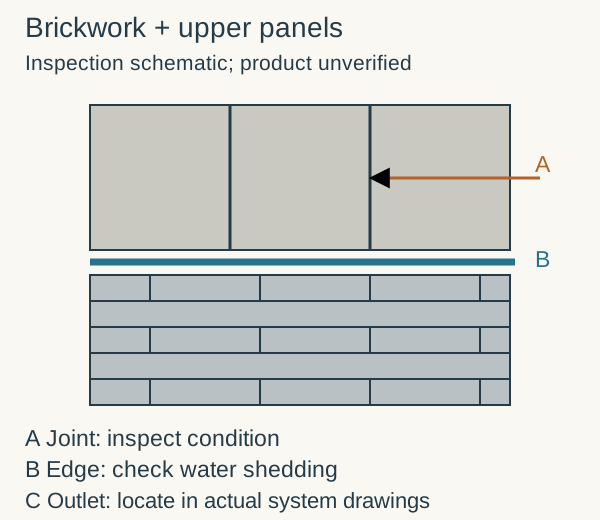
Takeaway: Locate the real water-control path and access route before setting a maintenance plan.
Where “low maintenance” goes wrong
- Choosing a material for low maintenance, then detailing it badly. Unsealed cut edges, blocked drainage and fixings specified for the wrong exposure undo the material’s advantage.
- Under-specifying fixings. Check fixing compatibility and corrosion risk for the specified exposure; panel durability alone does not clear attachments.
- Assuming factory finish means permanent finish. It means durable and consistent, not immune to impact damage.
- Ignoring the ground floor. Impact damage concentrates within reach. A different, tougher material for the lowest storey is often the right answer.
Deciding
- Establish access and who will maintain it. This usually reorders everything below.
- Confirm the fire requirement for the building height and jurisdiction — a hard constraint, not a preference.
- Prefer through-coloured over coated where the shortlist allows it.
- Prefer panelised over continuous where local replacement matters.
- Check that fixings and sealants are specified for the same exposure as the cladding.
Where weight rather than maintenance is the governing constraint, start instead with lightweight facade materials. For the full shortlist, see exterior wall cladding materials compared and the facades and exterior design guide.
Frequently asked questions
What is the single lowest-maintenance cladding?
No material family has a universal lowest-maintenance rank. Compare the actual mortar, coating, sealant, fixing and drainage details in the project exposure, including access and repair requirements.
Does low maintenance mean no maintenance?
No. Follow the system's inspection and maintenance instructions, including drainage and any sealants or coatings. Low maintenance does not remove those tasks, and their intervals depend on the products and exposure.
How long do facade sealants last?
Service life depends on the product, the joint design, the movement it accommodates and the exposure, and manufacturers publish figures for their own products. Compare the sealant guidance with the other components; no universal order of replacement is established here.
Is timber ever low maintenance?
Untreated timber left to weather to grey is low maintenance if you accept the appearance change and the species suits the exposure. Where a coated appearance is required, include the product's coating renewal instructions in the comparison.
Sources
- Building Envelope Design Guide — Whole Building Design Guide, National Institute of Building Sciences Accessed August 27, 2026.