Topic guide
Sustainable and Climate-Responsive Design
Much of a building's energy demand is set by its geometry, orientation and envelope — decisions made early and usually costly to revisit. This guide covers passive design strategies that work without equipment, what thermal mass and insulation each actually do, and how durability and life-cycle thinking change material decisions.
What sustainable building design means
The international reference point is ISO 15392:2019, Sustainability in buildings and civil engineering works — General principles. It treats sustainability as the contribution a building makes to sustainable development across its whole life cycle, from inception to end of life, and across three dimensions — environmental, economic and social. It applies to new and existing buildings and to the materials, products and services involved in them.
It sets out nine general principles: continual improvement, equity, global thinking and local action, holistic approach, involvement of interested parties, long-term consideration and resilience, responsibility, risk management, and transparency.
Two points in the standard matter in practice. It deliberately sets no performance levels, so nothing in it can be used as a benchmark for claiming a building is sustainable. And it states that there are no definitive methods for measuring sustainability. Sustainable building design is therefore best understood as a way of making decisions — judged over the building’s life, with the trade-offs stated — rather than as a label a design either has or lacks.
Sustainable design and green building
The two terms are used interchangeably, and neither proves anything on its own. In ISO 15392’s sense, sustainability covers economic and social effects as well as environmental ones; “green building” is more often used for environmental performance, and frequently as shorthand for a particular rating scheme. When either label is attached to a project, ask what was assessed, against which benchmark, and over which part of the building’s life. The published window rules and the LEED point bands that sit under that question are in green building design, passive solar, and LEED metrics.
Living Building Challenge and green building in general
“Green building” is a general term with no single owner or definition. The Living Building Challenge is different: it is a specific programme run by the International Living Future Institute, which describes it as “a philosophy, advocacy tool, and certification program”. It is organised into seven performance areas, which it calls petals: Place, Water, Energy, Health + Happiness, Materials, Equity and Beauty. The programme website links to the LBC 4.1 manual, launched in April 2024.
So “living building” is not a synonym for a sustainable or green building. It refers to a project pursuing or holding certification under that programme, and whether a project is certified — and at which level — is a matter for the programme’s own records, not something the label implies. The programme’s requirements are set in its own manual; this guide does not summarise or assess them.
The order of decisions, and where it comes from
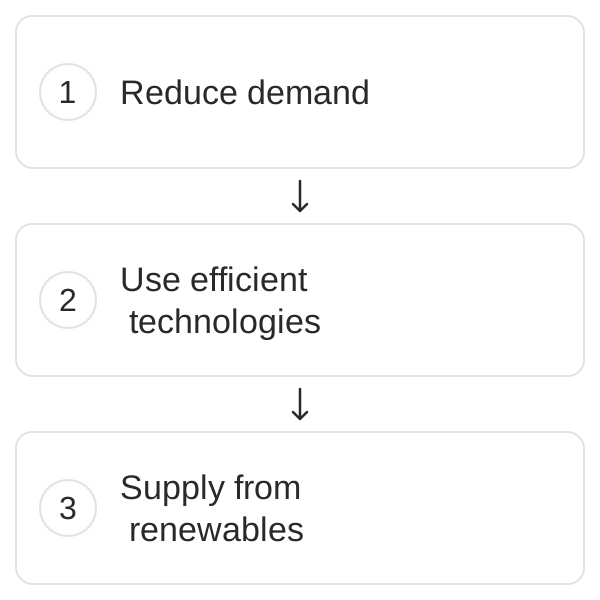
UN-Habitat’s guide to sustainable building design for tropical climates sets out a three-step sequence for energy:
- Reduce demand. Minimise the energy the building needs through its shape, orientation, internal layout, the position of openings and sun shading.
- Use efficient technologies. Meet the remaining demand for heating, cooling, hot water and lighting with the most efficient systems available.
- Supply from renewables. Maximise the share of renewable energy.
In practice, the decisions that reduce demand — form, orientation, envelope and passive measures such as shading, daylight and ventilation — are made early and are usually harder and costlier to change later than equipment. Equipment and generation do not reduce that demand; they supply it.
This sequence concerns energy in use, not every sustainability issue. Assess materials and embodied carbon alongside it — from the structure at the form stage to insulation and equipment — rather than waiting until the energy decisions are complete.
Sustainable building features and where each is covered
The table below is this site’s own grouping of topics into the guides that cover them. It is a navigation aid, not a ranking taken from a standard or guideline.
Swipe sideways to see the other columns. The first column stays visible.
| Group | Feature | Where it is covered |
|---|---|---|
| Form and orientation | Building shape, orientation, room placement | Passive design basics |
| Envelope | Insulation continuity, airtightness, thermal bridges | Building envelope design and airtightness and thermal bridging |
| Envelope investigation | Leaks, condensation, drafts and cold spots | Building envelope problems and testing — match observations to an inspection question and understand test limits. |
| Envelope | Shading and glazing by orientation | Climate-responsive facades |
| Passive measures | Daylight | Daylighting strategies |
| Passive measures | Thermal mass, where the climate supports it | Thermal mass vs insulation |
| Rating metrics | Passive-solar window rules and LEED point bands | Green building design, passive solar, and LEED metrics |
| Alongside every decision | Material choice and service life | Sustainable material selection and durable building materials |
| Alongside every decision | Embodied carbon | Embodied carbon in buildings |
Equipment and on-site generation are not covered by a separate guide here.
Who does what: sustainable design engineering
“Sustainable design engineering” is not one role. The architect leads form, orientation, envelope and material decisions; building services engineers design and size the heating, cooling, ventilation and renewable systems; structural engineers determine the frame and foundations, where much of the embodied carbon sits. Energy and life-cycle assessments are usually carried out by specialists working across those roles. This site explains the decisions; it does not provide design, engineering or certification services, and responsibility for a specific building rests with the licensed professionals appointed to it.
Thermal mass and insulation are not alternatives
They do different jobs and are routinely confused.
Insulation resists heat flow; thermal mass stores heat. For the natural charging and cooling strategy discussed here, ask how heat reaches the mass and how it is released later. A large day–night swing alone does not establish suitability.
The US Department of Energy’s natural-ventilation guidance describes night air cooling a home and its thermal mass, with cool nights and regular breezes as favourable conditions. For that strategy, warm nights or unsuitable outdoor air can limit cooling; check local temperature, humidity, air quality and ventilation access. This is not a claim that mass has no role in a mechanically conditioned building. Compare the functions in thermal mass vs insulation.
Coordinate shading and glazing
Assess orientation, external shading, glazing and ventilation together before sizing cooling systems. Their effect depends on climate, exposure and the building’s use. The UN-Habitat guide covers these decisions in a tropical context; use local climate data when applying its examples elsewhere.
Consider the whole service life
Compare material options over the same study period and function. Include maintenance, replacement, access for repair and end-of-life assumptions, rather than using purchase price as the only criterion. Document those assumptions so another team can understand the comparison.
Where to check guidance
Reliable guidance names its publisher, states its edition or date, and says what it covers and what it does not. The references used across this section are of that kind:
- ISO 15392:2019 (preview) — general principles of sustainability for buildings and civil engineering works.
- Sustainable Building Design for Tropical Climates, UN-Habitat, 2014 — climate-specific principles and applications for Eastern Africa.
- 2030 Challenge for Embodied Carbon, Architecture 2030 — voluntary embodied carbon reduction targets.
- Living Building Challenge, International Living Future Institute — a specific certification programme with seven performance areas; version 4.1 launched April 2024.
- Natural Ventilation and Cooling, US Department of Energy Building Science Education — night cooling and outdoor-air conditions; accessed 8 October 2026.
Material marketing that uses the same words — “sustainable”, “green”, “eco” — without a publisher’s method, scope or date is a claim, not guidance.
In this topic