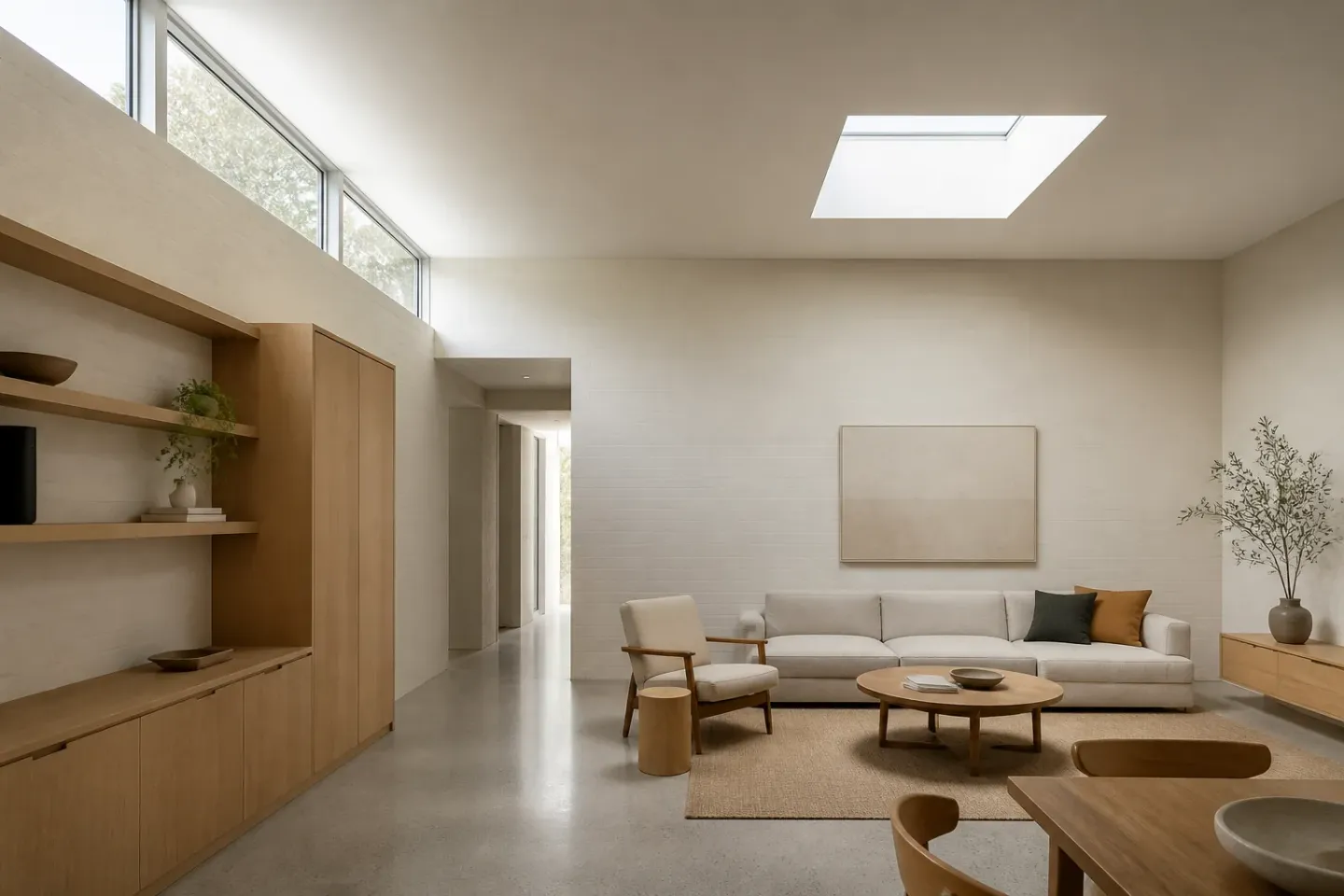
More glass is not necessarily better daylight
Enlarging a window can increase daylight, including beyond the near-window zone. Whether it solves the room’s problem depends on the opening geometry, obstructions and glazing, while additional solar gain and glare also need checking. WBDG’s Daylighting guidance addresses integrated design for federal new construction and major renovation; its concepts help screen a design, not certify a house.
Check head height and area together
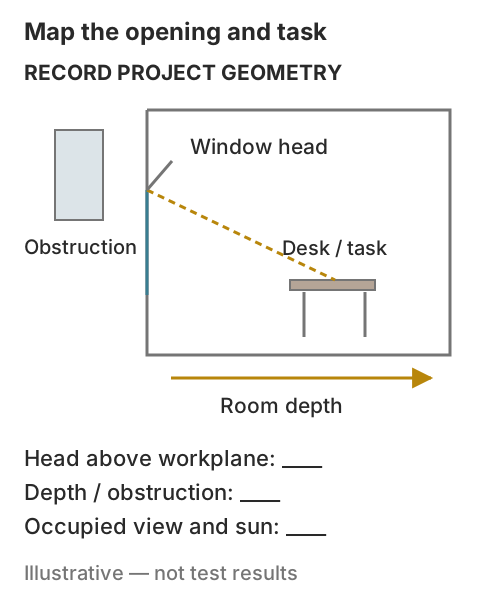
WBDG describes higher window heads as a general way to extend penetration and separates daylight openings from view openings. Treat that as a design variable alongside room depth, window width, reveal geometry, visible sky and surface reflectance, rather than declaring a tall narrow window the winner at every site.
Compare the near and rear workplane positions in the model or mockup. Record blocked sky and direct sun separately; raising a head behind an obstruction may not deliver the intended benefit.
Depth is the other half
A deep single-aspect room can have a dim rear zone. The distribution depends on opening geometry, sky access, glazing and reflectance; it is not independent of window area.
Options to compare for the actual site, without a universal effectiveness ranking:
- A second aspect — a window on another wall, ideally a different orientation
- Light from above — rooflight, lantern, light well
- Raising the head height on the existing aspect
- Reducing the room depth, or accepting that the back is a low-light zone and planning it accordingly
- Borrowed light through internal glazing from a brighter adjacent space
Deciding this belongs with the plan, not with the window schedule — see how site orientation affects house design.
Check brightness, contrast and the occupied view
Glare is not just a contrast ratio. Source luminance, its size and position, the background and the occupant’s view affect discomfort; bright reflections can obscure details on shiny task surfaces. WBDG calls for direct-sun control at tasks and occupants’ eyes, with suitable blinds or shades where needed.
Measures to assess for glare and useful daylight together:
- Light-coloured surfaces around the opening, so the window is not a bright hole in a dark wall
- Splayed reveals, which give a gradient rather than a hard edge
- Two aspects, which balance the room rather than making one wall the sole source
- Bouncing light off a ceiling or a light shelf, which distributes rather than concentrates it
- Avoiding direct sun on task surfaces, which is an orientation and shading question
Screens are the common casualty. Assess a workspace facing a bright window from the actual seated view; brightness, contrast and screen reflections determine whether a change is needed.
Quantity, distribution, and control
Three separate requirements that get bundled:
Swipe sideways to see the other columns. The first column stays visible.
| Requirement | Governed by | Typical fix |
|---|---|---|
| Quantity | Opening area, sky view, obstruction | More or better-placed openings |
| Distribution | Head height, room depth, number of aspects | Second aspect, light from above |
| Control | Orientation, shading, surface finishes | External shading, blinds, splayed reveals |
A room can fail on any one. Check all three before changing the opening area.
Daylight and heat are the same opening
Daylight openings also need a solar-gain check. A fixed overhang can intercept some high-angle sun; low-angle east/west sun is harder to control with a horizontal projection. Its effectiveness still depends on sun angle, azimuth and the opening/overhang geometry: assess fins, screens or movable shading against the project sun paths rather than assuming an overhang can never shade those elevations.
So daylight strategy and shading strategy have to be designed together, or one will be sacrificed to the other. See passive design basics for the shading geometry and building envelope design for how openings interrupt the control layers.
Checking a design
Use a separate record for each room. WBDG recommends evaluating performance for the building’s climate, including illuminance and glare; these entries are screening inputs, not pass thresholds.
| Check | Project entry |
|---|---|
| Opening height, room depth and aspects | ____ |
| Dim rear zone and alternative light source | ____ |
| Sky obstruction, including seasonal planting | ____ |
| Direct sun on desk, screen or seated view | ____ |
| Reveal and surrounding surface finishes | ____ |
| Model assumptions, conditions and unresolved result | ____ |
Takeaway: Compare useful light and glare at occupied positions before increasing glazing.
The sustainable and climate-responsive design guide covers where daylight sits among the other envelope decisions.
Frequently asked questions
Does a bigger window mean a brighter room?
A larger opening can raise daylight levels, but its benefit at the back depends on head height, room geometry, visible sky and glazing. Compare near and rear task positions and assess glare and solar gain; window area alone does not establish useful distribution.
How deep can a room be and still be daylit from one side?
There is no universal figure, but penetration scales with window head height — the higher the head, the deeper useful light reaches. Deep rooms lit from one short end are the classic failure. Add a second aspect or light from above.
What causes glare?
Source luminance and contrast both matter, together with source size and position in the field of view. Direct sun and bright reflections can also disturb tasks. Review the seated view and screen position, rather than using room brightness alone as the test.
Are rooflights better than windows?
A rooflight can access sky unavailable to a wall window, but output depends on glazing, shaft geometry, orientation and obstruction. Compare daylight distribution, direct-sun control and solar gain for the actual design; rooflights are not universally better.
Sources
- Daylighting — Whole Building Design Guide, National Institute of Building Sciences Accessed October 8, 2026.