Two different jobs
Confusing storage with resistance can produce a poorly matched envelope strategy. Insulation resists heat flow across an assembly. Thermal mass stores heat and changes the response to changing heat inputs. The Department of Energy’s passive-design guidance discusses both interior and exterior mass; neither is universally useful or useless.
Side by side
Swipe sideways to see the other columns. The first column stays visible.
| Check | Insulation | Thermal mass |
|---|---|---|
| Mechanism | Resists heat flow | Absorbs, stores and releases heat |
| Project aim | Limit unwanted loss or gain | Shift heat release and moderate changing conditions |
| Position | Check continuity and thermal bridges | Check coupling to the room or exterior |
| Operating inputs | Temperature difference, gains and conditioning | Gains, heat-removal path and occupancy schedule |
| Energy outcome | Assess complete envelope and operation | Assess complete envelope and operation |
| Substitute for the other? | No | No |
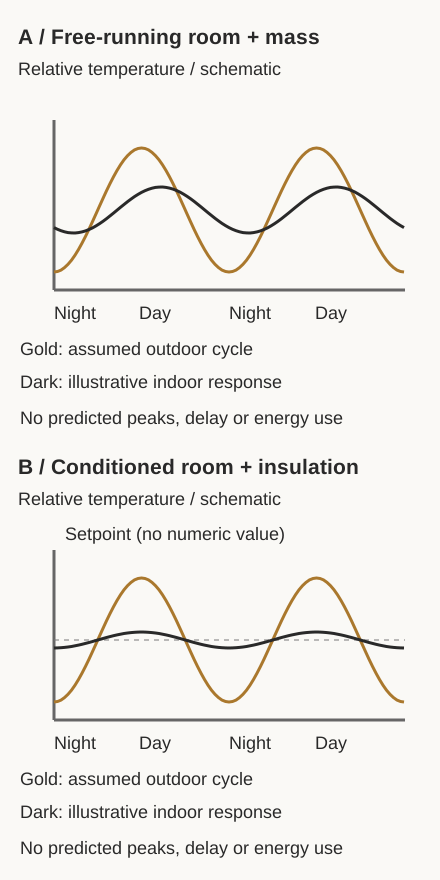
Takeaway: Compare heat resistance and storage as separate design inputs. The stacked chart above this article is that comparison. It is a schematic, not a measurement.
When mass pays off
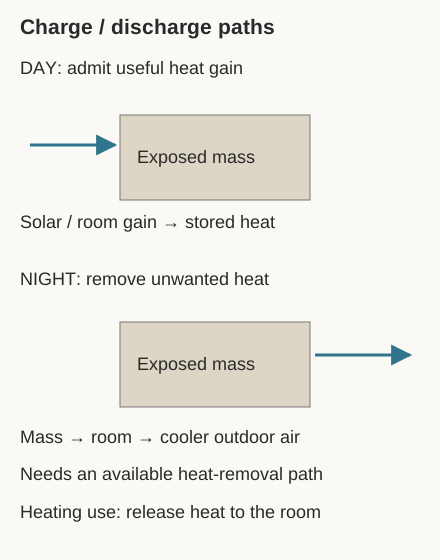
For passive cooling, identify when the mass can absorb unwanted gains and when cooler air or another heat sink can remove them. A useful day/night temperature difference can support this cycle, but it is not a universal eligibility threshold.
For passive heating, solar gains can charge exposed mass for release later. The DOE consumer guide describes this use alongside insulation, glazing and heat distribution.
Exposure matters: Your Home notes that insulating coverings can reduce heat exchange between mass and the room. Check the proposed finish rather than assuming all covered mass is ineffective.
Takeaway: Identify both the heat input and the useful release or removal period.
When mass does very little
Warm nights and limited heat removal. In an unconditioned building, stored daytime gains may remain when cooling is wanted. Your Home distinguishes this case from air-conditioned buildings.
Little useful heat input. Mass can moderate changes without proving an energy saving. Identify solar, internal or controlled heating gains before calling storage beneficial.
Intermittent occupancy. The desired warm-up or cool-down time matters. Assess the operating schedule rather than assuming heavyweight or lightweight construction always wins.
Takeaway: These passive examples do not determine performance in mechanically conditioned buildings.
How they work together
External insulation with exposed internal mass is one way to retain thermal coupling to the room while limiting exchange through the envelope. It is not the only effective arrangement.
DOE’s Thermal Mass section explicitly includes exterior mass. Its value depends on the assembly, changing exterior conditions and the building’s operation. Do not discard it solely because it is outside the insulation, or infer equivalent performance from equal insulation values.
Takeaway: Assess the complete wall and operating conditions before choosing the mass position.
What to check on a real project
Use this self-use record for the proposed strategy:
| Input | Project record |
|---|---|
| Climate | Day/night temperatures by season; climate-data reference: ____ |
| Assembly | Mass material, thickness, exposed area, insulation position and coverings: ____ |
| Charging | Solar/internal/heating gains and times: ____ |
| Heat removal or release | Ventilation or cooling path, available conditions and controls: ____ |
| Operation | Occupancy, conditioning setpoints and schedule: ____ |
| Assessment | Comfort aim, model/report reference and unresolved inputs: ____ |
Takeaway: Confirm the charge and release conditions before assigning an energy benefit.
Continue with passive design basics, climate-responsive facade strategies and the sustainable and climate-responsive design guide. For a weight-constrained wall, see lightweight facade materials.
Frequently asked questions
Can thermal mass replace insulation?
No. They do different things. Mass with no insulation in a cold climate loses heat steadily to the outside; it just does so with a delay. Insulation is the layer that reduces the loss.
Does thermal mass work in a hot humid climate?
For passive night cooling, warm nights may leave insufficient opportunity to remove stored heat. An air-conditioned building has different controls and heat-removal paths; climate alone does not establish whether mass helps.
Does a mass floor still work under carpet or timber?
Coverings change heat exchange with the room. Compare the thermal resistance of the proposed finish and underlay, and confirm how the mass will receive and release heat rather than treating every timber or carpet system alike.
How much mass is useful?
Useful mass depends on material properties, thickness, exposed area, heat inputs and operating cycle. Evaluate those inputs together in a project-specific thermal calculation for the local diurnal temperature swing.
Sources
- Thermal mass — passive heating, cooling and coverings — Australian Government, Your Home Accessed October 8, 2026.
- ZEB Technologies — Passive Design Techniques, Thermal Mass section — U.S. Department of Energy Accessed October 8, 2026.
- Consumer Guide to Passive Solar Home Design — U.S. Department of Energy Accessed October 8, 2026.