
What it covers
Embodied carbon is the greenhouse gas emissions associated with a building’s materials across their life: extracting and manufacturing them, transporting them, installing them, maintaining and replacing them, and dealing with them at the end.
It is the counterpart to operational carbon, which comes from running the building. As envelopes and systems improve, operational emissions fall and embodied emissions become a larger share of the total — which is why the topic has moved from specialist to mainstream.
Scope is the whole problem with the numbers
An embodied carbon figure is not comparable to another one unless three things match:
- The life-cycle stages included. Cradle-to-gate covers manufacture only. Cradle-to-grave adds transport, construction, use, maintenance and end of life. These produce very different numbers for the same product.
- The functional unit. Per kilogram, per square metre, per square metre at a stated performance. A comparison per kilogram between a dense material and a light one is close to meaningless.
- The reference service life assumed.
Read the EPD’s declared unit, modules and service-life assumptions; the project assessment period must also match. A figure quoted without them is not data, and should be treated the way any performance claim without its test conditions is treated — see sustainable material selection criteria.
What the Architecture 2030 embodied carbon targets actually say
The targets most often quoted for embodied carbon come from Architecture 2030’s 2030 Challenge for Embodied Carbon. As the organisation states them, the embodied carbon of buildings, infrastructure and associated materials should immediately meet a maximum global warming potential 40% below today’s industry average, then 45% or better in 2025, 65% or better in 2030, and zero by 2040. These are the published target milestones, not evidence of achieved reductions; 2025 is now a past milestone. The metric is kilograms of CO₂-equivalent per functional unit.
| Published milestone | Reduction target to read with its scope |
|---|---|
| Immediate target in the challenge | 40% below its stated industry-average baseline |
| 2025, past milestone | 45% or better; achievement must be checked separately |
| 2030 | 65% or better |
| 2040 | Zero GWP |
| Reporting boundary and unit | State benchmark/version, stages and kg CO₂e per functional unit |
The FAQ recommends whole-life assessment and accepts cradle-to-gate as a minimum with omissions stated. Match that boundary before interpreting a percentage.
Which life-cycle stages. Architecture 2030’s FAQ recommends that an assessment cover all life stages, from raw material extraction to disposal — cradle-to-grave — and says that at a minimum the LCA or Environmental Product Declaration should be cradle-to-gate. Where stages are left out, it asks for a statement of the omissions. In practice the stages run:
- Product stage — extraction and manufacture, the cradle-to-gate part
- Transport and construction — getting materials to site and installing them
- Use and maintenance — including repair and replacement over the service life
- End of life — removal, processing and disposal
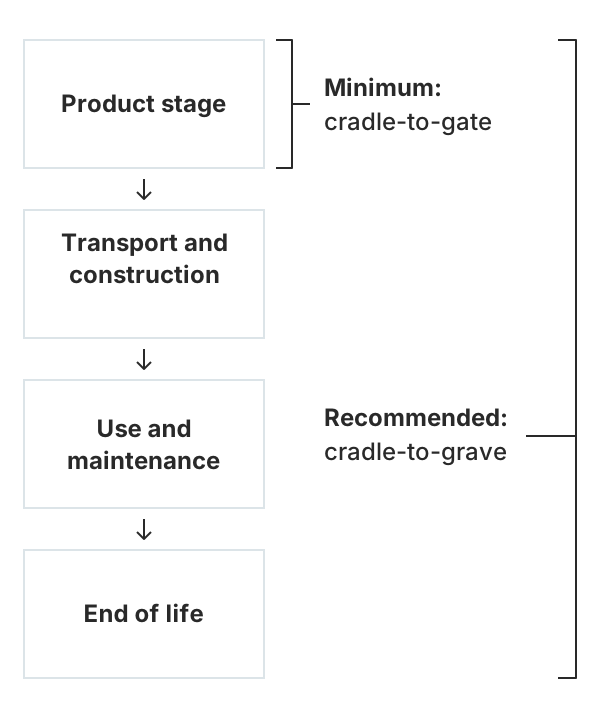
The challenge page itself does not fix which of these a project must report, so a claim of “65% below” that covers only the product stage and one that covers the whole life are not the same claim.
Which baseline. The FAQ’s benchmark discussion is a historical 2011–2013 development plan: it anticipated representative inventory data followed by generic/representative product-category EPDs. Its future-tense wording does not establish which benchmarks were completed or are current. Name the actual benchmark, version and reference period used on this project.
Which functional unit. A reduction per kilogram of material and a reduction per square metre of floor area answer different questions, for the reasons set out above.
Architecture 2030 is not the AIA 2030 Commitment
The two are often run together. Architecture 2030 is a separate organisation that issued the 2030 Challenge; the American Institute of Architects created the AIA 2030 Commitment in response, as a framework for firms to track their progress. Architecture 2030 describes the difference as one of scope: the Commitment applies only to AIA members and adds firm-level matters such as action plans, water and indoor air quality. The required reporting the AIA lists for the Commitment is operational — energy use intensity baselines, predicted energy use, lighting power density and the energy code used. A firm reporting under the Commitment has therefore not, by that fact alone, shown that a project meets the embodied carbon targets.
How to use the targets on a project
The challenge is a voluntary target, not a code requirement; local regulations and certification schemes set their own rules and boundaries, and those govern where they apply. Used as a design benchmark, it is most useful when the project team:
- States which life-cycle stages its assessment covers, and lists the omissions.
- Names the baseline or benchmark the reduction is measured against.
- Uses the same functional unit and boundary for every option being compared.
- Runs the comparison early enough to change significant contributors in the project breakdown.
A finishes-only target after the frame is fixed can leave major contributors unexamined — which is the subject of the next section.
Where it actually sits
Effort tends to go where the visible choices are — finishes, cladding, insulation — while the mass sits elsewhere.
| Element group | Project assessment question |
|---|---|
| Substructure and structure | What do foundations, frame and floors contribute for this building type? |
| Envelope | Which layers and replacements are counted? |
| Finishes and fit-out | Does frequent refurbishment change the whole-life share? |
| Services | Are shorter-lived equipment and replacements included? |
Do not assign a universal ranking. A new-build frame deserves early review, while a frequently refitted interior can shift the whole-life distribution toward finishes and services.
The decisions that move it most
Build less. Compare retention, repair and reduced new construction against replacement using the same functional performance and assessment period; do not assume a universal winner.
Choose the structural system deliberately. Frame material, span, grid and foundation type are settled early and should be assessed before the design is fixed.
Design for a long service life. Example, assumed inputs: compare the same 1 m² finish delivering the same function over 60 years. If replacement occurs at years 15, 30 and 45 after installation at year 0, there are four installations. Assuming identical manufacturing/installation impact per installation and disposal impact per removed unit, including final disposal at year 60, count 4 × manufacturing/installation and 4 × disposal. No replacement is installed at the endpoint. Transport, maintenance and other modules need separate consistent treatment; do not multiply a whole-life EPD that already includes replacements. This is counting logic, not an emissions estimate. See durable building materials and life-cycle thinking.
Design for disassembly. Mechanical fixings rather than adhesives, fewer permanently bonded composites, accessible fixings. Recyclability is a property of a material; whether it gets recycled is a property of the assembly.
Reduce material where it is not working. Optimised structural design removes mass that was there for convenience rather than need.
Where effort is commonly misplaced
- Optimising finishes while leaving the structure unexamined. Review the project breakdown, including recurring fit-out, before choosing priorities.
- Comparing material categories rather than products. Variation within a family is often larger than between families.
- Ignoring service life, so a low-impact material that lasts fifteen years is scored against one that lasts fifty.
- Treating recyclability as a result. It is a possibility, and only if the assembly can be taken apart.
What to ask for
Record these fields before comparing EPDs; blank entries remain questions for the assessment team.
| EPD comparison record | Project entry |
|---|---|
| Product, EPD/version and validity | ____ |
| Declared/functional unit and required performance | ____ |
| Included modules, omissions and treatment of D | ____ |
| Assessment period, service life and replacements | ____ |
| Benchmark/version and matching boundary | ____ |
- Environmental Product Declarations for the significant products, with scope and unit stated.
- A whole-building assessment early enough to influence the structure, not after it is fixed.
- Reference service lives, with the basis for them.
- An end-of-life route, and confirmation the assembly allows separation.
And keep the sequence right: embodied carbon is applied to options that already satisfy the hard constraints of fire, structure and code — see how architects select building materials. The sustainable and climate-responsive design guide covers where it sits among the other decisions.
Frequently asked questions
What is the difference between embodied and operational carbon?
Operational carbon comes from running the building — heating, cooling, lighting, equipment. Embodied carbon comes from its materials across their life. As buildings become more efficient to run, embodied carbon becomes a larger share of the total.
Where is most embodied carbon in a building?
Typically the structure and substructure — foundations, frame, floors — because they are the largest mass of the most process-intensive materials. Finishes and fit-out matter more in buildings that are refitted frequently.
What are life-cycle stages A1 to C4?
A1–A3 is the product stage; A4–A5 covers transport to site and installation; B1–B7 covers use, maintenance, repair, replacement, refurbishment, operational energy and water; C1–C4 covers demolition, transport, waste processing and disposal. Operational B6/B7 must be distinguished in an embodied-carbon total; D is beyond the system boundary.
Does timber automatically have lower embodied carbon?
Often lower than the alternatives, but not automatically, and the accounting is contested — sourcing, transport, treatment, service life and what happens at end of life all matter. Compare specific products with declared data rather than comparing material categories.
Is the AIA 2030 Commitment the same as the Architecture 2030 embodied carbon challenge?
No. Architecture 2030 is a separate organisation that issued the 2030 Challenge; the AIA created the AIA 2030 Commitment in response, as a framework for member firms to track progress. The Commitment's required reporting described by the AIA covers operational energy, while Architecture 2030's 2030 Challenge for Embodied Carbon sets the embodied carbon reduction targets.
Sources
- 2030 Challenge for Embodied Carbon — Architecture 2030 Accessed October 6, 2026.
- Frequently Asked Questions — Architecture 2030 Accessed October 6, 2026.
- The AIA 2030 Commitment — The American Institute of Architects Accessed October 6, 2026.
- EPD International: module table (LB35 declaration listing) — EPD International Accessed October 8, 2026.