The short answer, and why it is conditional
Some flexible stone products are approved for external use. Many are not. The category answer is therefore useless, and the only answer that means anything is a written statement from the manufacturer covering this product, in this exposure, on this substrate.
Stone decor, backing, adhesive and substrate all have product-specific exposure limits. A stone face does not establish the weathering performance of the composite. See what is flexible stone veneer for the composition.
What the outdoors does to it
UV. Check the composite’s published weathering evidence, including the stone decor and exposed edges. Do not infer backing embrittlement or a failure sequence from appearance alone.
Temperature cycling. Surface temperatures far exceed air temperature, especially on dark stone and on west-facing elevations. Every cycle works the adhesive bond and any dissimilar-movement joint.
Liquid water and vapour. A fully bonded layer does not itself provide an open drainage cavity. That does not rule out drainage elsewhere in the wall, or inward/outward diffusion drying through permeable materials. Building Science Corporation’s rain-control guidance treats liquid drainage, moisture storage and drying separately. Confirm the substrate, membranes, joints and terminations; water retention depends on that whole build-up. See ventilated facade vs direct-applied cladding.
Freeze-thaw. Water in or behind the sheet expanding on freezing. Governed by absorption and by whether the build-up can dry.
Salt exposure needs separate confirmation for the product, adhesive, trim and fixings; general exterior approval does not settle it.
Impact at accessible levels needs assembly-specific evidence and a repair plan, rather than a thickness-based assumption.
Exposure changes the answer
Slate-Lite’s public processing instructions/data sheet, 11 June 2026, lists facade use and UV-weathering information, but excludes its ICE PEARL and GREEN PEARL limestone decors from wet/outdoor use. It lists substrates and recommends a compatible adhesive; those statements do not verify every substrate/exposure combination. The sheet reviewed here does not establish a freeze-thaw result for the proposed wall: obtain that evidence separately. This is a manufacturer document example, not a product recommendation or our testing.
Record exact product/decor: ____; document/version: ____; substrate and adhesive documents: ____.
| Exposure to record | Applicable evidence and unresolved item |
|---|---|
| Sheltered / temperate | Exterior permission for exact decor and substrate: ____ |
| Driving rain | Junctions, drainage and drying provisions: ____ |
| Hot / high UV | Weathering conditions and exposed edges: ____; see hot-climate facade checks |
| Freeze-thaw | Product and assembly evidence, not an inferred UV result: ____ |
| Coastal / de-icing salt | Specific exposure approval for all components: ____ |
| Accessible / public | Impact evidence and replacement procedure: ____ |
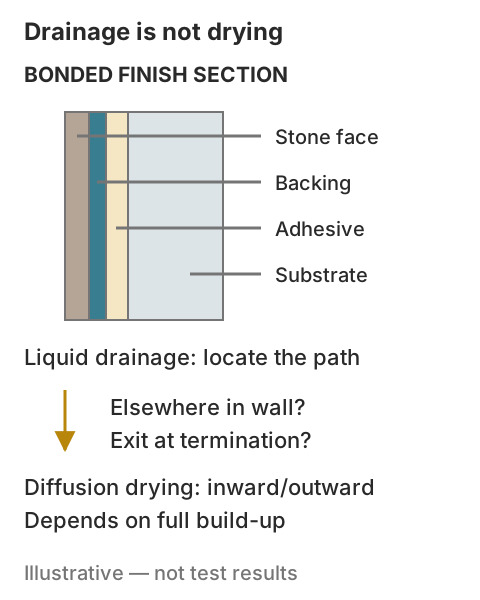
Takeaway: An unresolved exposure stays unresolved until the matching product and wall documents address it.
What to obtain before specifying
- Written confirmation of external suitability for the exact product, naming the exposure.
- An approved compatible adhesive system, with its substrate, exposure and preparation conditions. Approval does not necessarily require the manufacturer’s own brand.
- Approved substrates and the required preparation, in writing.
- Fire classification for the product in the complete tested assembly, at your building height and occupancy, under local regulations. A polymer-bound composite does not behave like the stone it resembles, and for facades this is frequently a hard constraint rather than a preference.
- UV and temperature evidence for the product and exposed edges.
- Water absorption and freeze-thaw data, where the climate requires it.
- Junction, edge, termination and penetration details from the manufacturer, not improvised on site.
- Warranty terms for external use, including what voids them and how long they run.
If item 1 is not available in writing, the answer is no — for this project, whatever is true of the category in general.
Where it is a reasonable exterior choice
Consider it where weight or geometry favours a bonded sheet and the exact product, substrate and exposure are documented. Sheltering alone does not establish suitability; keep a maintenance and replacement plan.
Where it is not
Defer specification wherever the relevant exposure, substrate, impact or fire conditions remain unresolved. A wet, freezing, coastal or accessible location needs matching evidence; the climate label alone is neither approval nor an automatic rejection.
For the wider shortlist of exterior options, see exterior wall cladding materials compared and low-maintenance facade materials; the facades and exterior design guide covers where the system decision sits.
Frequently asked questions
Why do some suppliers say it is fine outdoors?
Because some products genuinely are approved for external use in defined exposures. The claim is only meaningful attached to a specific product, a stated exposure and a written approval. A general category claim is not a specification.
What actually fails first outdoors?
There is no universal failure order. Inspect the stone face, edges, backing, bond and substrate, then compare the observed damage with the exact product documents. A sound-looking face cannot confirm the concealed bond or wall condition.
Does it survive freeze-thaw?
That depends on water absorption and on whether the assembly can dry, both of which are product and build-up properties. In freeze-thaw climates this needs explicit confirmation for the product, not a general reassurance.
Is it suitable for a coastal site?
Salt exposure is an additional and separate question from general exterior use. Ask specifically about coastal or marine exposure, and confirm the adhesive and any trim or fixing components are rated for it too.
Sources
- Building Envelope Design Guide — Whole Building Design Guide, National Institute of Building Sciences Accessed August 28, 2026.
- Slate-Lite processing instructions and data sheet (11 June 2026) — R&D GmbH (Slate-Lite); manufacturer public document, not independent testing Accessed October 8, 2026.
- BSD-013: Rain Control in Buildings — Building Science Corporation Accessed October 8, 2026.