Definition first: identify the face and backing
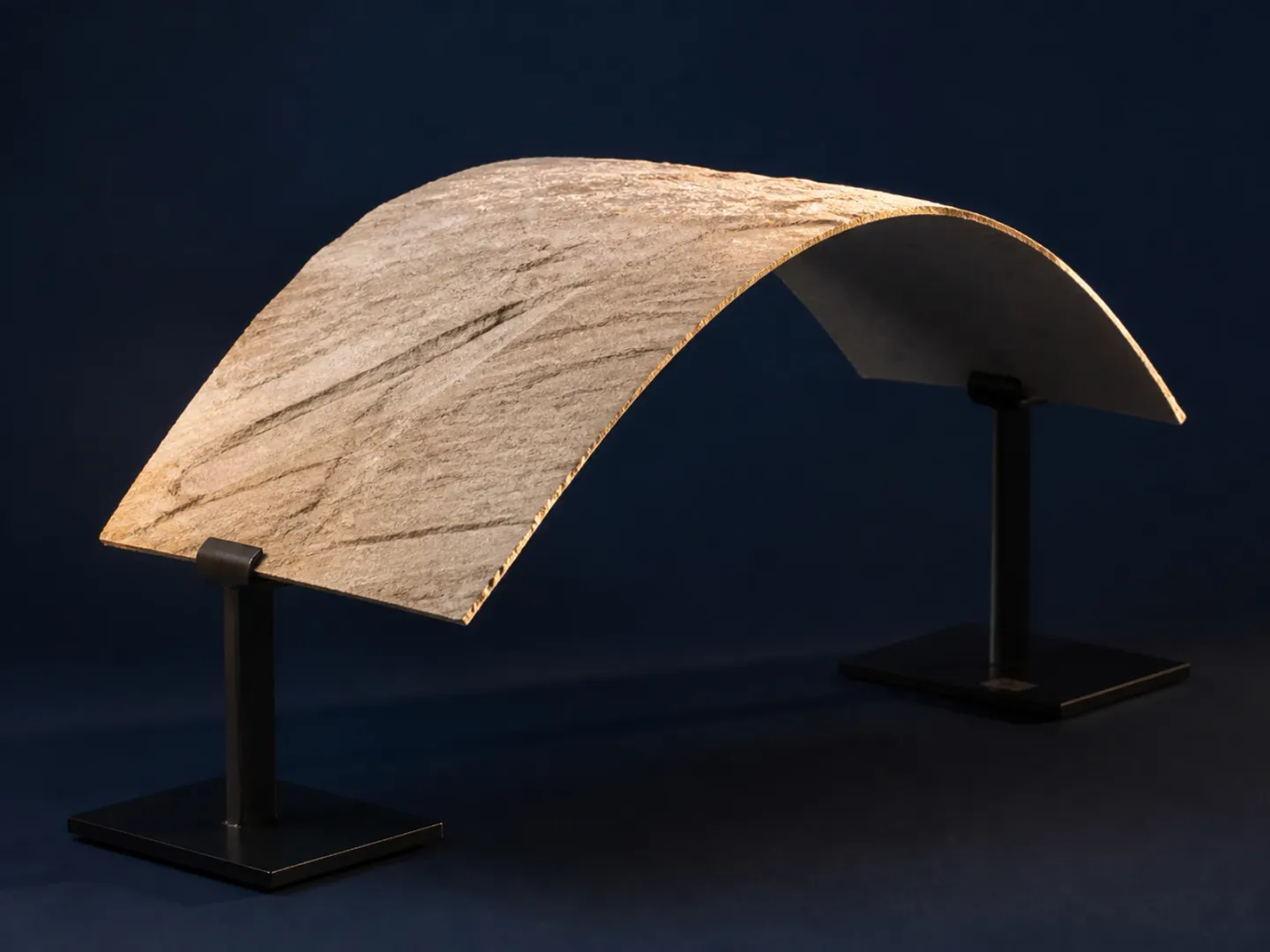
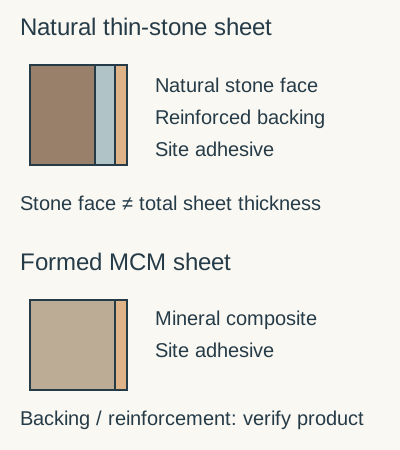
Slate-Lite’s June 2026 data sheet describes a natural stone layer on glass-fibre-reinforced polyester. The installation adhesive is a separate site-applied layer. PHOMI’s public econiclay technology description instead describes mineral feedstocks processed into powders, activated and formed into MCM. These are named examples, not a complete recipe for every product sold as “flexible stone”.
Swipe sideways to see the other columns. The first column stays visible.
| Construction | Visible layer | What to verify |
|---|---|---|
| Natural stone-faced sheet | Continuous natural thin-stone face | Stone identity, backing, face and total thickness |
| Formed MCM sheet | Formed mineral composite surface | Named mineral formulation, reinforcement if any, total thickness |
| Conventional stone veneer | Stone unit | Support or bond system and unit dimensions |
What the distinction does not prove
MCM need not be free of stone-derived minerals: PHOMI lists stone offcuts among inputs. The distinction here is a formed mineral composite versus a continuous natural stone face. Do not infer a universal stone-layer thickness, manufacturing route or long-term record from those names.
The backing, laminate and installation adhesive transfer loads within the finish assembly; that does not make them architectural structure.
Where the service life actually lives
Because the stone is a facing, the things that decide how long the installation lasts are:
- The backing, and its resistance to UV, heat and moisture
- The adhesive, and whether it suits the substrate, the exposure and the temperature range
- The substrate, which must be sound, flat, stable and correctly prepared
- The joint and edge detailing, where water and mechanical damage start
That is the same list that governs any adhered thin finish. See how to compare material durability and maintenance for how to compare those honestly, and how architects select building materials for where this sits in the wider decision.
Where it makes sense
- Curved and irregular surfaces that rigid sheet materials cannot follow — columns, curved walls, soffits
- Renovation where weight is the governing constraint and the existing structure cannot carry conventional stone
- Interior feature surfaces at moderate exposure, where the stone character is wanted and the mass is not
- Situations where a stone appearance is required over a substrate that could never carry stone
Where it is the wrong choice
- Anywhere the substrate is unsound, moving or poorly prepared. An adhered thin finish cannot bridge a substrate problem; it inherits it.
- High-impact locations without suitable product evidence. Confirm impact resistance and repair requirements rather than inferring them from the stone appearance.
- Where local repair matters but removal and visual matching have not been checked.
- Where required service-history evidence is missing. Request records for the exact product, exposure and installation system; no category-wide age comparison is made here.
- Anywhere the fire requirement has not been confirmed for the specific product and tested assembly. A polymer-bound composite has different fire behaviour from the stone it resembles, and this must be checked rather than assumed.
Read thickness and mass from the same document
As a document-reading example, Slate-Lite’s 11 June 2026 sheet, page 5, gives approximately 1.5–2.5 mm total thickness and 1.5–2.8 kg/m² mass per area for its named product line. It separately describes a stone layer of approximately 0.1–1.4 mm. These are manufacturer figures, not class-wide ranges or measurements by this site. The ranges do not identify one specific decor’s paired thickness and mass: request those together before a load calculation.
Record: product / decor ______; revision ______; total thickness / unit ______; mass per area / unit ______; stone-face thickness or “not disclosed” ______.
What to get from the data sheet before specifying
- Total thickness, stone layer thickness, and weight per square metre for the exact product
- Backing composition, and its UV and temperature limits
- Approved substrates and required preparation
- Approved adhesive system and the installation conditions in the warranty
- Fire classification, with the standard and the tested assembly named
- Whether the product is approved for the intended exposure, interior or exterior
- Water absorption and freeze-thaw performance, if relevant to the location
- Warranty terms, and what voids them
If items 1, 3, 4 and 5 are not available in writing for the specific product, the material cannot be responsibly specified, whatever the sample looks like. For how to judge the sample itself, see material samples, finish boards and mockups and the building materials and finishes guide.
Frequently asked questions
Is flexible stone veneer real stone?
For a natural stone-faced product, the face is stone and the backing is a separate composite layer. Confirm the composition for the named sheet; the marketing term alone does not distinguish it from mineral composites.
How is it different from MCM flexible tile?
MCM is a formed mineral composite rather than a continuous natural stone thin-face layer. PHOMI’s public technology description includes soil, stone offcuts and mining residues among possible mineral inputs, so “contains no quarried stone” is not a defensible category-wide distinction.
How thick and how heavy is it?
Use total thickness and mass per square metre from the same product row and revision. Total sheet thickness is not stone-face thickness. If the face thickness is not disclosed, record it as unknown.
Can it be repaired?
Check the adhesive and removal procedure for the installed product. Replacement can damage the backing or substrate, and a replacement natural-stone sheet may differ visually. Keep spare material and confirm the repair sequence.
Sources
- Slate-Lite instructions and data sheet, 11 June 2026 — Slate-Lite Accessed October 8, 2026.
- econiclay technology — PHOMI Accessed October 8, 2026.