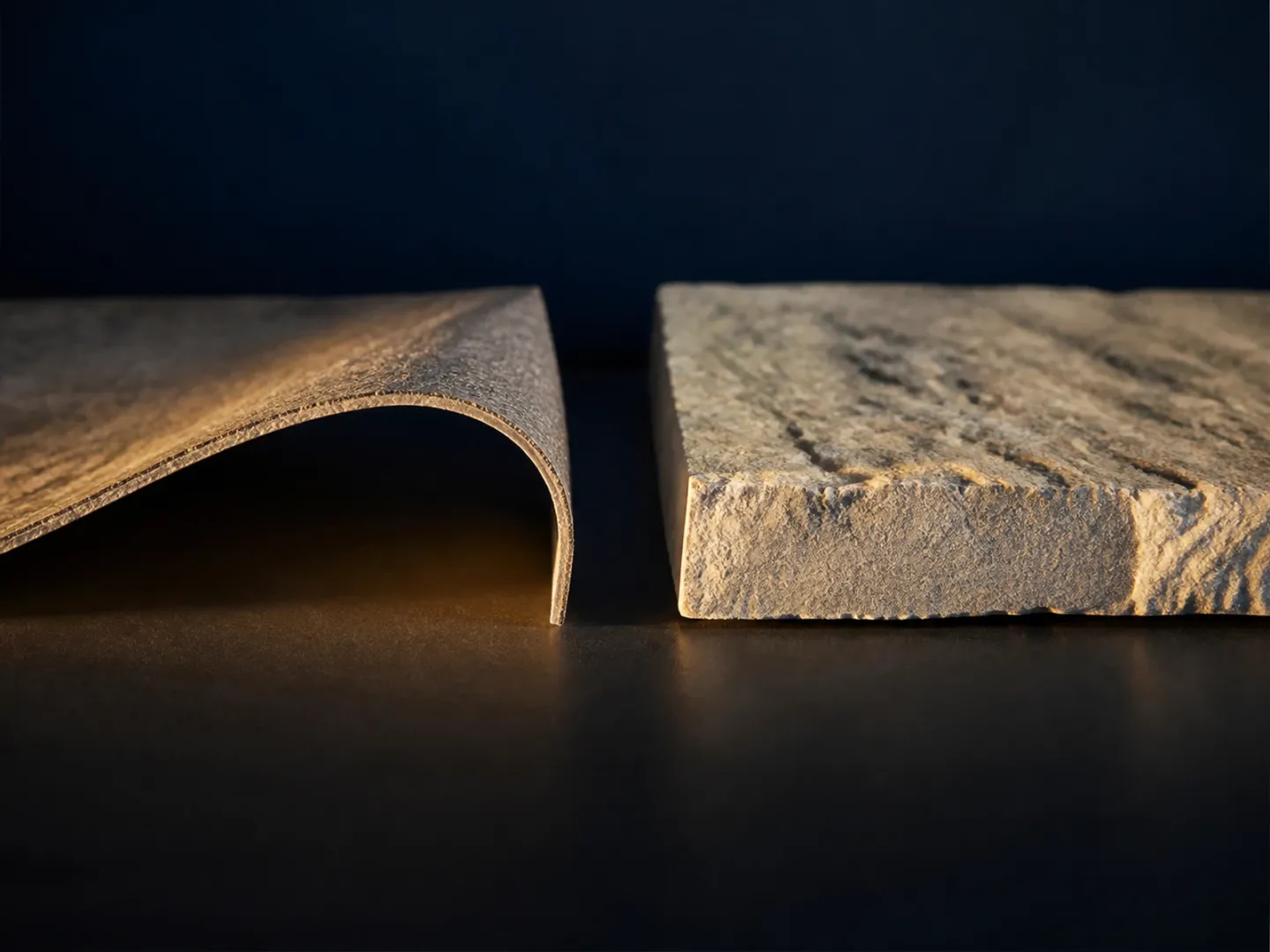
Two different things wearing the same name
Natural Stone Institute standards distinguish adhered, mechanically anchored, and separately supported stone veneer systems, whereas Slate-Lite’s technical instructions define flexible stone as a thin natural stone facing laminated to a reinforced carrier and bonded to a prepared substrate.
| Decision | Flexible bonded sheet (A) / conventional stone (B) |
|---|---|
| Weight allowance | A: verify sheet plus substrate/adhesive; B: verify units, support and fixings |
| Curvature | A: use documented radius; B: check segmented units or fabricated geometry |
| Impact exposure | A and B: compare exact thickness, stone and assembly evidence, not a universal low/high rating |
| Repair route | A: confirm bond removal and substrate repair; B: confirm adhered-unit, anchor or masonry access |
Conventional stone veneer is not one self-supporting slab system. Thin adhered stone transfers loads through its bond and backing wall. Mechanically anchored panels use designed supports and anchors. Supported/stacked masonry veneer is another system to evaluate; its bearing and lateral restraint must be shown in the project detail. Each system needs its own load and movement detail.
Flexible stone here means a thin stone facing on a carrier, adhered to a compatible substrate; see what is flexible stone veneer. Slate-Lite’s 11 June 2026 instructions list substrates and an adhesive recommendation. They do not justify comparing every flexible sheet with every conventional stone assembly on cost or longevity.
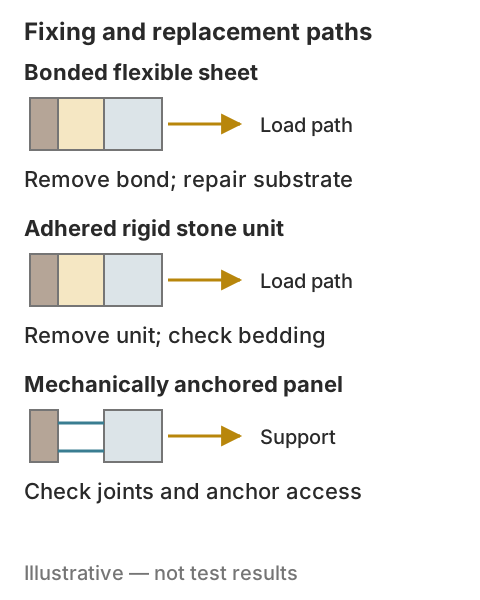
The comparison is therefore conditional: a rigid unit bridges only the deviation allowed by its designed support or bedding; an adhered thin unit also needs a suitable substrate. Local replacement depends on joints, bond or anchor access and matching stock, rather than a guaranteed material advantage. For both routes, confirm fire requirements for the complete proposed assembly.
When flexible veneer is the defensible choice
Weight is the governing constraint. Compare installed assembly loads with the existing structure’s allowance, rather than assuming a slab is excluded — see lightweight facade materials for how weight limits get established.
The geometry rules out slabs. Curved walls, columns, soffits and irregular surfaces. Compare the sheet’s permitted bend with segmented or fabricated rigid stone; the resulting joints, supports and costs are project-specific.
The substrate is sound and will stay sound. Adhered thin finishes inherit substrate problems rather than bridging them, so a stable, correctly prepared backing is a precondition rather than a preference.
When traditional veneer is the defensible choice
Impact is likely. Ground floors, circulation, retail frontages, anywhere within reach. Request evidence for the exact stone thickness, support and finish; greater thickness alone does not prove the assembly meets the exposure.
Repairability matters. If damage over a long service life is expected, confirm whether one unit can be removed and reinstated without damaging neighbours or the substrate.
Edges and returns are visible. Where the design depends on reading stone as a material with thickness — deep reveals, exposed edges, returns at openings — a facing needs careful detailing to avoid looking applied, and sometimes cannot get there.
The project needs service-life evidence. Ask for comparable records under the proposed exposure and maintenance conditions, including freeze-thaw, bond-strength, and UV-exposure test reports for the specified veneer assembly.
How to decide
- Check the structural allowance first. If one system exceeds it, consider lighter conventional systems as well as flexible sheets, then check exposure suitability.
- Check the geometry. Record the curvature and compare permitted sheet bending with rigid-unit layouts.
- Assess impact exposure by level. Use evidence for each proposed assembly at accessible levels.
- Confirm the substrate — construction, flatness, movement, moisture, preparation.
- Confirm the fire requirement for the specific product and tested assembly, in your jurisdiction.
- Decide what happens after damage, and price that rather than assuming it will not occur.
- Only then compare appearance, using large samples at real viewing distance — see material samples, finish boards and mockups.
Steps 1 and 2 usually decide it. Where both products remain available, step 6 is the one that most often changes minds. For the framework this sits inside, see how architects select building materials and the building materials and finishes guide.
Frequently asked questions
Is flexible stone veneer cheaper?
There is no defensible category-wide price ranking here. Compare matching project quotations for preparation, substrate, adhesive or anchors, installed labour and future repair access. A lighter facing still needs a substrate and a load path to the structure.
Does flexible veneer look like real stone?
The face is real stone, so at close range it reads as stone. What differs is depth — a slab shows thickness at edges, reveals and returns, and a thin facing does not. Edge and corner detailing is where the difference becomes visible.
Which lasts longer?
No comparable long-term service-life dataset is supplied here. Obtain evidence for the exact stone, backing, attachment, exposure and maintenance regime. A product warranty or an installation detail does not establish a category-wide life expectancy.
Can flexible veneer go where traditional veneer cannot?
Some bonded sheets suit curves or lower load allowances that rule out a particular slab system. Confirm the permitted radius, substrate and orientation for the exact product. Conventional thin units or segmented stone may remain alternatives; the category name does not exclude them.
Sources
- Slate-Lite processing instructions and data sheet (11 June 2026) — R&D GmbH (Slate-Lite); manufacturer public document Accessed October 8, 2026.
- Exterior Adhered Stone Veneer: public course scope — Natural Stone Institute Accessed October 8, 2026.
- Dimension Stone Design Manual: Vertical Surfaces, public chapter scope — Natural Stone Institute Accessed October 8, 2026.