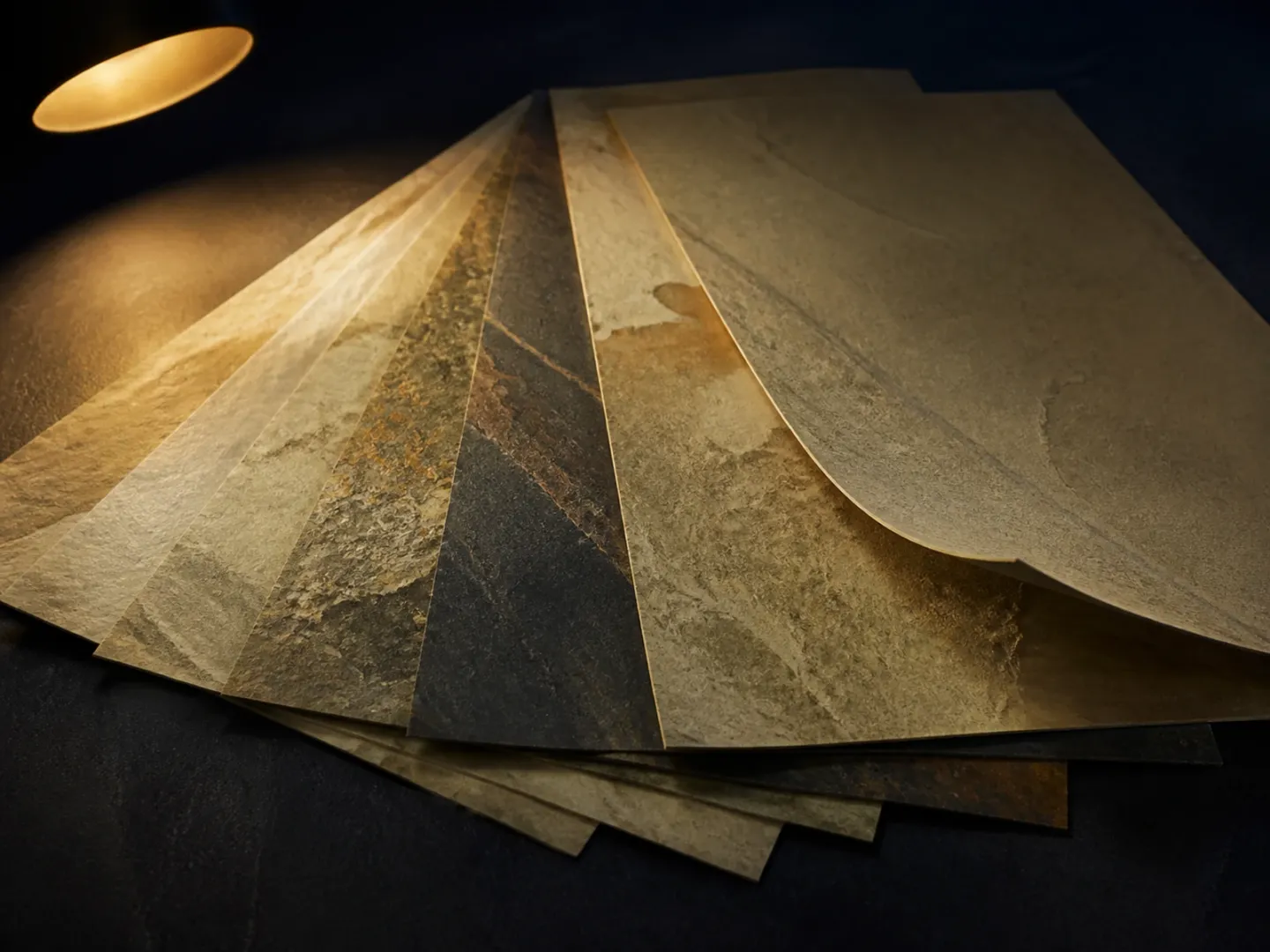
What the sample cannot tell you
A hand sample shows the face and cut edge; it cannot establish the installed backing, adhesive, substrate and junction performance. Review those documents alongside the visible surface.
So the sample and the paperwork are one submission, not two. A sample that arrives without the data sheet has not been submitted — it has been shown to you.
The general problems with small samples apply here as they do to any material, and they apply harder because sheet products carry a joint pattern that a swatch cannot show. See material samples, finish boards and mockups.
Judge the face properly
- At real size. At least one full sheet module and a joint. Sheet formats vary, so ask what the module is.
- At real distance. Almost always further than people hold a sample.
- In real light. Outdoors for external use, on the intended orientation, at more than one time of day.
- Wet as well as dry. Record the exact decor and treatment before comparing appearance. Slate-Lite’s public instructions say impregnation/sealing can deepen colour depending on decor and recommend a remnant trial. They do not prove that rain permanently darkens the whole category.
- Against the adjacent materials, not against a white desk.
Physical checks worth running
These are qualitative observations on spare pieces, not standard tests or acceptance thresholds. Agree any handling with the technical party; keep the approved reference sample intact. Record sample ID, decor/batch, treatment, date, photos and the question needing technical review.
Bending. Record the project curvature and permitted bend direction/radius from the product document before handling. On a spare piece, note face cracks or backing changes at the recorded curve; observations do not establish a minimum bend radius.
Cut edge/backing. Photograph the layer connection and any visible separation. If the technical party requests a peel attempt on a spare piece, record the method and damage; hand force cannot establish bond strength or a pass result.
Wet/dry. If permitted for the decor, record how it was wetted, drying conditions and appearance after drying. Note staining or edge change for review; do not impose an arbitrary soak duration.
Scratch/knock. Only on a spare piece with agreed handling, record the tool/contact and resulting mark. This does not certify impact resistance or suitability at public ground level.
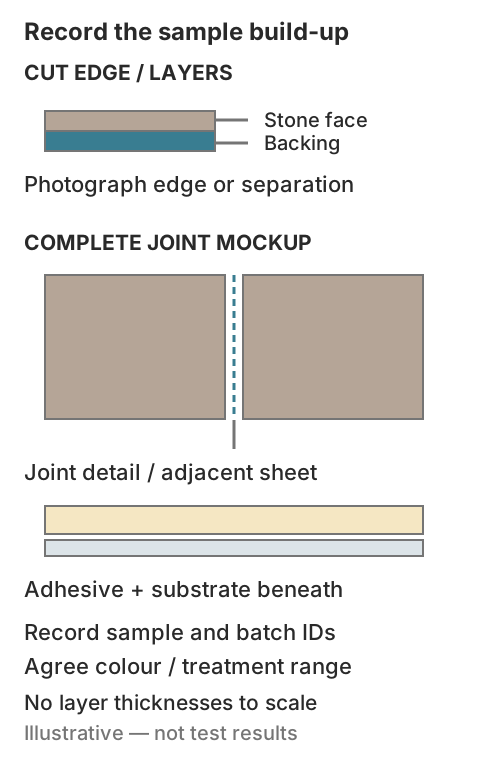
Takeaway: Send recorded observations and unresolved questions to the technical party; a neat sample is not proof of an accepted assembly.
Approve a range, not a piece
The face is natural stone, so it varies within a source and between batches. A single approved sample is not a usable standard, because the delivered material will not match it exactly and there is then no agreed basis for accepting or rejecting.
Ask for samples showing the acceptable extremes of colour, veining and texture, approve that range, and write it into the specification. This is the same discipline any natural material needs — see natural vs engineered building materials.
The paperwork that must arrive with it
| Document | Why it decides the specification |
|---|---|
| Current technical data sheet, exact product | Thickness, weight, limits — nothing else is a usable source |
| Approved adhesive system | Exact compatible product and approval conditions; it need not be the stone manufacturer’s own brand |
| Approved substrates and preparation | An adhered finish inherits substrate problems |
| Fire classification, standard and tested assembly | A polymer-bound composite does not behave like stone |
| Exterior approval and exposure, if applicable | See can flexible stone be used outdoors |
| Warranty terms and exclusions | Installation deviations commonly void them |
Where a mockup earns its cost
On a large area, a tight radius, an exterior elevation, or wherever the substrate is unusual. A built mockup allows the joint pattern, substrate preparation and workmanship to be reviewed together; only agreed tests can establish bond performance. Record what was approved — which is not something a sample can do.
Slate-Lite’s 11 June 2026 instructions recommend an adhesive and list substrate examples; use the matching adhesive instructions rather than interpreting the list as permission for every wall. Its colour-variation guidance supports requesting an agreed range, not treating one swatch as a guarantee. Verify adhesive compatibility and lot-to-lot colour variation against the manufacturer’s current technical data sheet.
| Acceptance record | Project entry |
|---|---|
| Sample IDs, decor and delivery batch | ____ |
| Approved colour/veining extremes and reference photos | ____ |
| Product, adhesive and protection document versions | ____ |
| Backing, substrate and complete joint mockup | ____ |
| Curvature, handling, wet/dry observations and photos | ____ |
| Unresolved question, reviewer and disposition | ____ |
For where sampling sits in the wider process, see how architects select building materials and the building materials and finishes guide.
Sources
- Building Envelope Design Guide — Whole Building Design Guide, National Institute of Building Sciences Accessed August 28, 2026.
- Slate-Lite processing instructions and data sheet (11 June 2026) — R&D GmbH (Slate-Lite); manufacturer public document Accessed October 8, 2026.