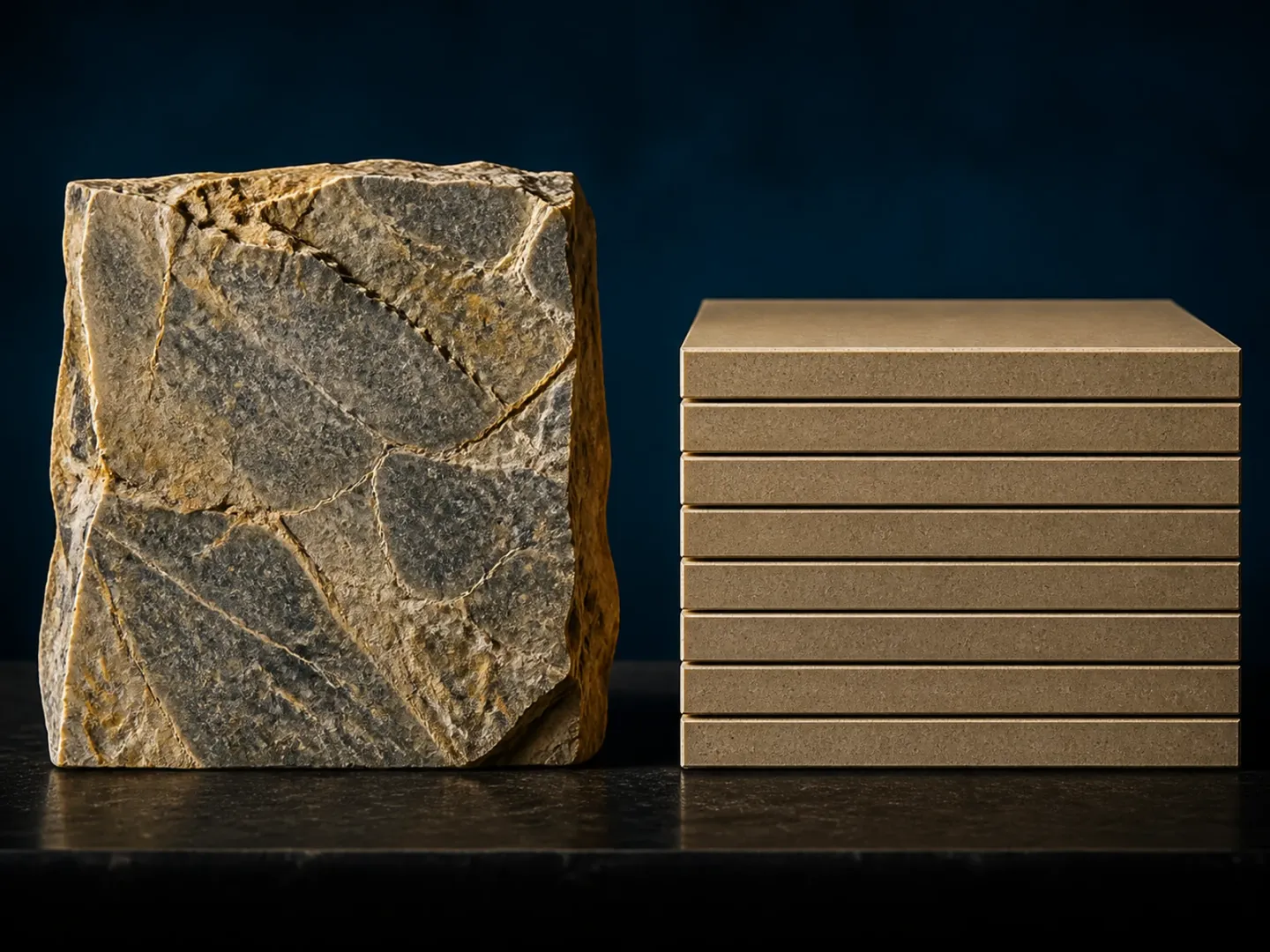
What follows from it
Swipe sideways to see the other columns. The first column stays visible.
| Check | Natural stone / solid timber | Manufactured products |
|---|---|---|
| Appearance | Approve a source and batch range | Check batch variation and printed-pattern repeats |
| Evidence | Grade and relevant product tests | Relevant product and assembly tests |
| Specification | Source, grade, size and sample range | Code, size, tolerances and installation conditions |
| Replacement | Check source, matching and spare units | Check discontinuation, substitutes and spare units |
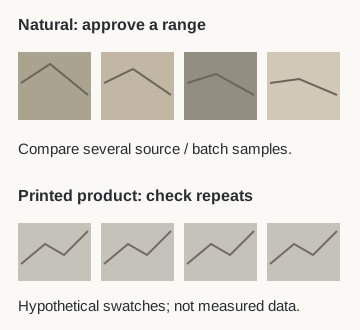
The distinction is about variation, not quality
This page uses an editorial grouping, not a universal material taxonomy. Natural means stone and solid timber retaining source variation; manufactured includes fired brick, fibre cement, porcelain, laminates and engineered timber. BIA’s public guidance describes fired brick as formed from clay or shale and fired, so it is not minimally processed clay.
Natural does not mean undocumented: AWC publishes lumber values by species and grade, and the Natural Stone Institute offers stone testing. Manufactured products also need product-specific batch tolerances, test conditions and installation instructions.
Where natural materials are the right answer
- Where variation is the point — the material is seen close, and consistency would read as flat.
- Where longevity in the specific exposure is proven locally, over decades, in the same conditions.
- Where conservation or planning requires matching existing fabric.
- Where the building will be maintained and repaired over a long life by people who understand the material.
Where engineered materials are the right answer
- Where large areas need to read as consistent.
- Where weight is constrained — see lightweight facade materials.
- Where the chosen product supplies the fire or structural evidence needed for the application; natural products can also supply evidence.
- Where matching matters and the actual supply and spare-stock plan supports future replacement.
- Where the format needed does not exist in the natural material — very large panels, very thin sections, curves.
Where each one goes wrong
Natural materials go wrong when the project cannot absorb variation: when a client approves a single sample and expects the delivered material to match it, when replacement pieces are needed and the source has changed, or when the material is used in an exposure that local practice has never tested it in.
Engineered materials go wrong when they are chosen from a brochure without reading the technical data sheet: when the installation requirements are treated as advisory, when cut edges are left unsealed, or when a product’s fire classification is assumed from its material family rather than confirmed for the tested assembly.
The question that separates them cleanly
What happens when one unit is damaged in year twelve? This is a hypothetical maintenance test, not a promised supply period.
For either group, check source or product continuity, substitute thickness and fixings, batch colour and weathering. A code can be discontinued; a quarry can change. Record the replacement plan now.
| Sample / stock check | Your record |
|---|---|
| Product / source | Code or quarry, grade, batch, date: ___ |
| Accepted appearance | Range board / layout photos; repeats checked: ___ |
| Replacement compatibility | Sizes, thickness, fixings, alternatives: ___ |
| Continuity / spares | Availability confirmed when; retained units and storage: ___ |
For the wider decision process, see how architects select building materials and the building materials and finishes guide. For how the same material behaves on either side of the envelope, see interior vs exterior wall materials.
Frequently asked questions
Are natural materials more sustainable?
Not automatically. Extraction, processing, transport distance, service life and end-of-life handling all matter, and a locally quarried stone and an imported one differ enormously. Compare specific products with life-cycle data rather than comparing categories.
Do engineered materials look artificial?
Some do and some do not, and it depends heavily on format, finish and how repetitive the pattern is across a large area. The reliable test is a large sample viewed at the real distance, not a swatch.
Which is easier to replace after damage?
Neither category guarantees easy replacement. Check whether the product or source remains available, whether dimensions and fixings match, and whether a new batch will match the installed, weathered surface. Retained spare units can reduce matching uncertainty for either group.
Can they be combined on one building?
Yes, and it is common. The usual approach is natural material where it is seen and touched at close range, and engineered material where area, weight or maintenance access governs.
Sources
- Technical Notes — scope for fired clay brick — Brick Industry Association Accessed October 8, 2026.
- Design values for lumber — FAQ — American Wood Council Accessed October 8, 2026.
- Natural stone testing services — Natural Stone Institute Accessed October 8, 2026.