Read the rating basis before comparing window numbers
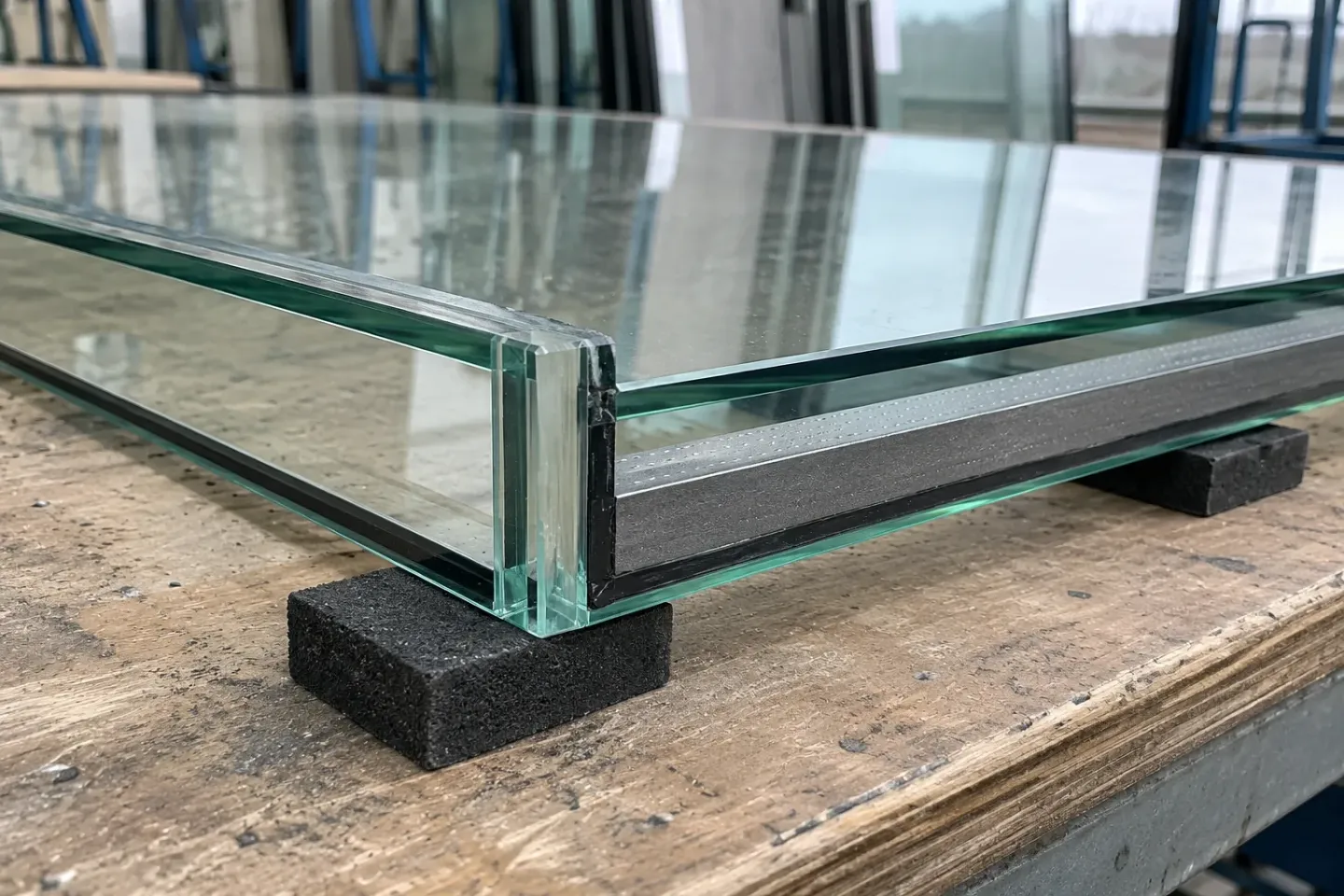
Selecting an exterior window from a single STC number can fail to control low-frequency road or rail rumble and lead to costly glazing rework. Confirm the rating classification, the tested specimen boundary and the one-third-octave band transmission loss table before comparing two window submittals.
A higher rating on a product sheet does not guarantee an equivalent decibel drop inside a finished room. Use this guide when comparing exterior window documents against outdoor noise so that center-of-glass tables, laboratory window assemblies and field isolation metrics are kept on separate, verifiable lines. For interior room echo and surface absorption rather than exterior facade transmission loss, see acoustic wall treatments and what they actually do.
Swipe sideways to see the other columns. The first column stays visible.
| Evidence item | What to check on the document | Why it changes the comparison |
|---|---|---|
| Noise source vs rating class | Speech/office sources (STC, ASTM E413-22) vs transportation spectrum (OITC, ASTM E1332-22) |
STC omits the 80 and 100 Hz bands where traffic, rail and aircraft energy concentrates |
| Tested specimen object | Center-of-glass IGU only vs complete framed window assembly (ASTM E90-23 / E1425-14(2023)) | Frame profiles, sash seals, hardware and weep slots create paths absent from glass-only tables |
| Configuration and size | Fixed vs operable sash, glass ply thicknesses, interlayer type, air/gas space and overall test dimensions | Low-frequency transmission loss and OITC vary with specimen size, edge restraints and operable seals |
| Frequency-band table | One-third-octave band Sound Transmission Loss (dB) from 80 to 4,000 Hz | Two windows with the same single-number STC or OITC can transmit different low- vs high-frequency spectra |
| Concurrent fenestration checks | Reported air leakage, operating force and latching force per ASTM E1425-14(2023) / AAMA 1801 | Confirms an operable window was not over-clamped or artificially caulked shut to inflate its lab score |
| Lab vs field basis | Lab diffuse-field TL (STC, OITC) vs field directional facade metrics (OINIC, FOITC(θ), AOITC(θ) per ASTM E966-18a) |
Lab ratings represent an upper limit; outdoor incidence angle and perimeter flanking alter built performance |
How does STC differ from OITC in noise spectrum and frequency range?
STC (Sound Transmission Class, ASTM E413-22) evaluates airborne sound attenuation from 125 to 4,000 Hz for speech and indoor building noise, whereas OITC (Outdoor-Indoor Transmission Class, ASTM E1332-22) evaluates 80 to 4,000 Hz against an A-weighted reference spectrum of outdoor transportation noise.
In the public Significance and Use section of ASTM E413-22 (updated May 2022), the classification states that its single-number ratings correlate in a general way with subjective impressions of speech, radio, television and similar sources in offices and buildings. Section 4.1 explicitly states that E413 is not appropriate for sources with significantly different spectra, including machinery, industrial processes, musical instruments and transportation noises such as motor vehicles, aircraft and trains, and directs facade comparisons to Classification E1332.
ASTM E1332-22 (updated August 2022) calculates a single-number rating from the difference between the overall A-weighted sound level of a reference source spectrum (Table 1 of the standard, which averages three transportation spectra: aircraft takeoff, road traffic and diesel locomotive) and the A-weighted spectrum remaining after subtracting the specimen’s transmission loss in each one-third-octave band.
Swipe sideways to see the other columns. The first column stays visible.
| Rating dimension | STC (ASTM E413-22) | OITC (ASTM E1332-22) |
|---|---|---|
| Primary invoking lab test | ASTM E90-23 (and ASTM E1425-14(2023) for fenestration) | ASTM E90-23 (and ASTM E1425-14(2023) for fenestration) |
| One-third-octave band range | 125 Hz to 4,000 Hz (16 bands; Note 1 compares ISO 717-1:2020 at 100–3,150 Hz) | 80 Hz to 4,000 Hz (18 bands; requires the 80 and 100 Hz bands per §4.2–4.3) |
| Target sound sources in scope | Speech, radio, television and office/interior building noise (§4.1) | Ground and air transportation noise with strong low-frequency energy: road traffic, diesel locomotive, aircraft takeoff (§1.1, §4.1) |
| Explicit scope exclusions | Machinery, industrial processes, musical systems, motor vehicles, aircraft and trains (§4.1) | Sources differing markedly from Table 1, such as industrial noise with high levels below 80 Hz, stage 3 jet aircraft, high-speed freeway tire noise, sirens and train horns (§1.4, §4.1) |
| Related field ratings | NIC, NNIC, ASTC (invoked via room-to-room Test Method ASTM E336-25a) |
OINIC(θ), AOITC(θ), FOITC(θ) (invoked via facade Guide ASTM E966-18a) |
Two standard boundaries affect how you read window submittals:
- Check whether the 80 Hz band was actually measured. According to ASTM E1332-22 §4.3, laboratories historically omitted measurements below 100 Hz because of chamber volume accuracy limits in E90 and E966. After studies showed that the 80 Hz one-third-octave band is required for acceptable correlation with transportation noise, Test Method E90 (when testing facade elements, exterior doors or windows) and Guide E966 required reporting the 80 Hz band. Older glazing tables often start at 100 Hz and mark
OITC*as an estimate. - Do not treat OITC as universal for every outdoor source. ASTM E1332-22 §4.1 and §1.4 warn that because the Table 1 reference spectrum is heavily weighted toward low frequencies, using OITC where the actual outdoor noise is dominated by higher-frequency tire whine on high-speed freeways, stage 3 jet aircraft, emergency sirens or train horns can over-specify low-frequency mass, while industrial sources peaking below 80 Hz fall outside E1332’s scope altogether. Where the site noise spectrum differs from the reference curve, E1332 §1.3 advises selecting facade elements using specific one-third-octave band transmission loss values alongside the project’s measured outdoor spectrum.
Takeaway: For exterior windows exposed to urban road, rail or aircraft corridors, require OITC alongside one-third-octave band data down to 80 Hz rather than relying on STC alone.
Does the report test center-of-glass only or the complete window assembly?
A center-of-glass insulated glass unit (IGU) table does not establish the STC or OITC of a complete window assembly; full-window qualification requires testing the glass inside its specific framing, sash, gasket and hardware system under ASTM E90 and ASTM E1425.
Glass manufacturers routinely publish acoustical data tables for unframed monolithic lites, laminated lites and IGUs. Those figures measure how airborne sound traverses the glass plies and airspace when sealed directly into a laboratory filler opening. Once that same IGU is glazed into an aluminum, vinyl, fiberglass or wood window frame, sound also interacts with frame chambers, glazing beads, mitered joints, operable sash perimeter seals, locking points and drainage weep slots.
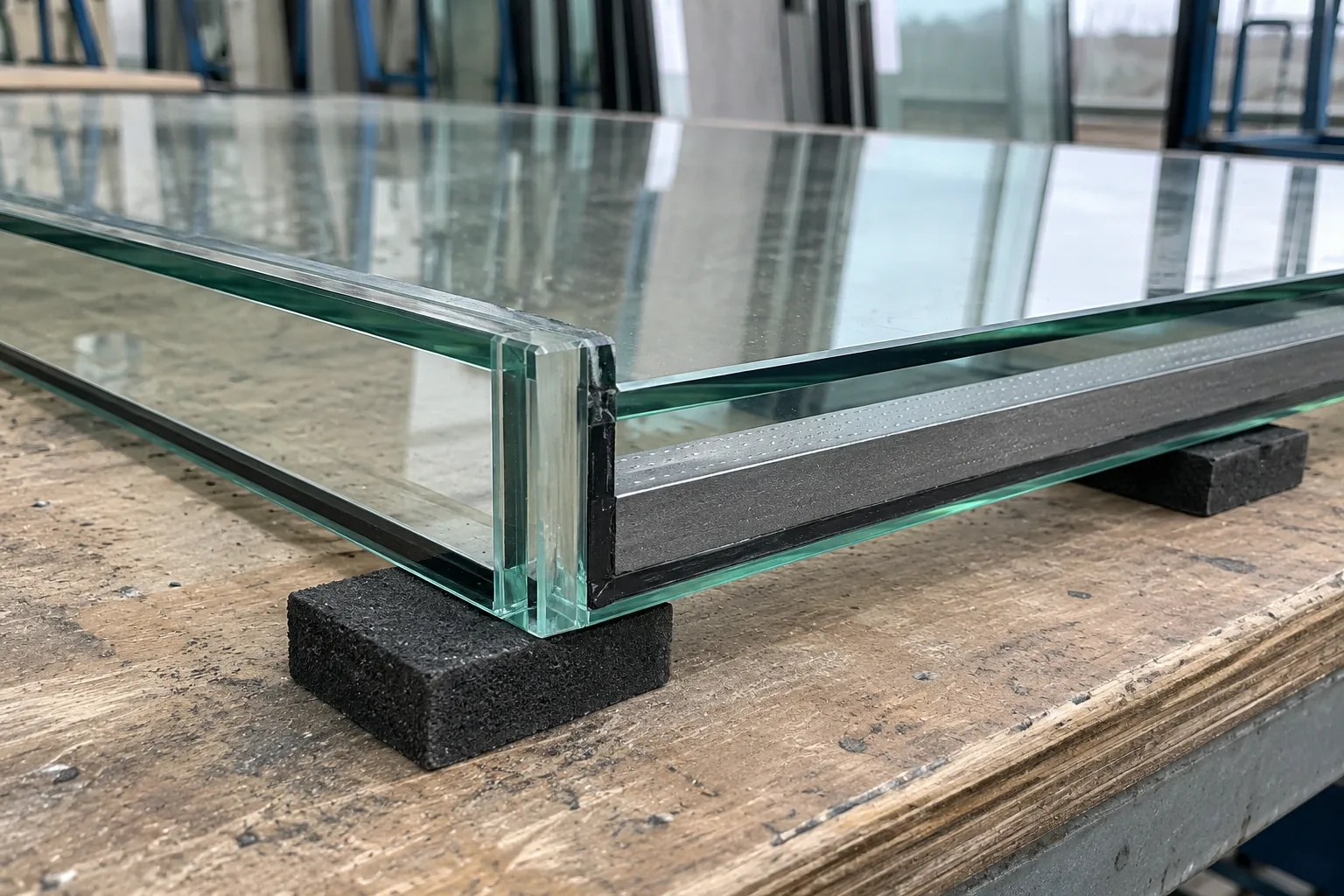
In The Construction Specifier’s January 2021 review of FGIA standards, Fenestration and Glazing Industry Alliance standards director Steven Saffell notes that the AAMA Curtain Wall Manual (CWM) guide specification (§5.2.3.7) explicitly requires acoustical testing per ASTM E90 and ASTM E1425 on the specified glass rigidly supported in framing of the same product family, adding: “Glass-only test results shall not be acceptable.”
When reviewing a complete window laboratory report prepared under ASTM E1425-14(2023) (updated February 2023) and AAMA 1801 (Voluntary Specification for the Acoustical Rating of Windows, Doors, and Glazed Wall Sections), verify four test conditions documented in the public scopes:
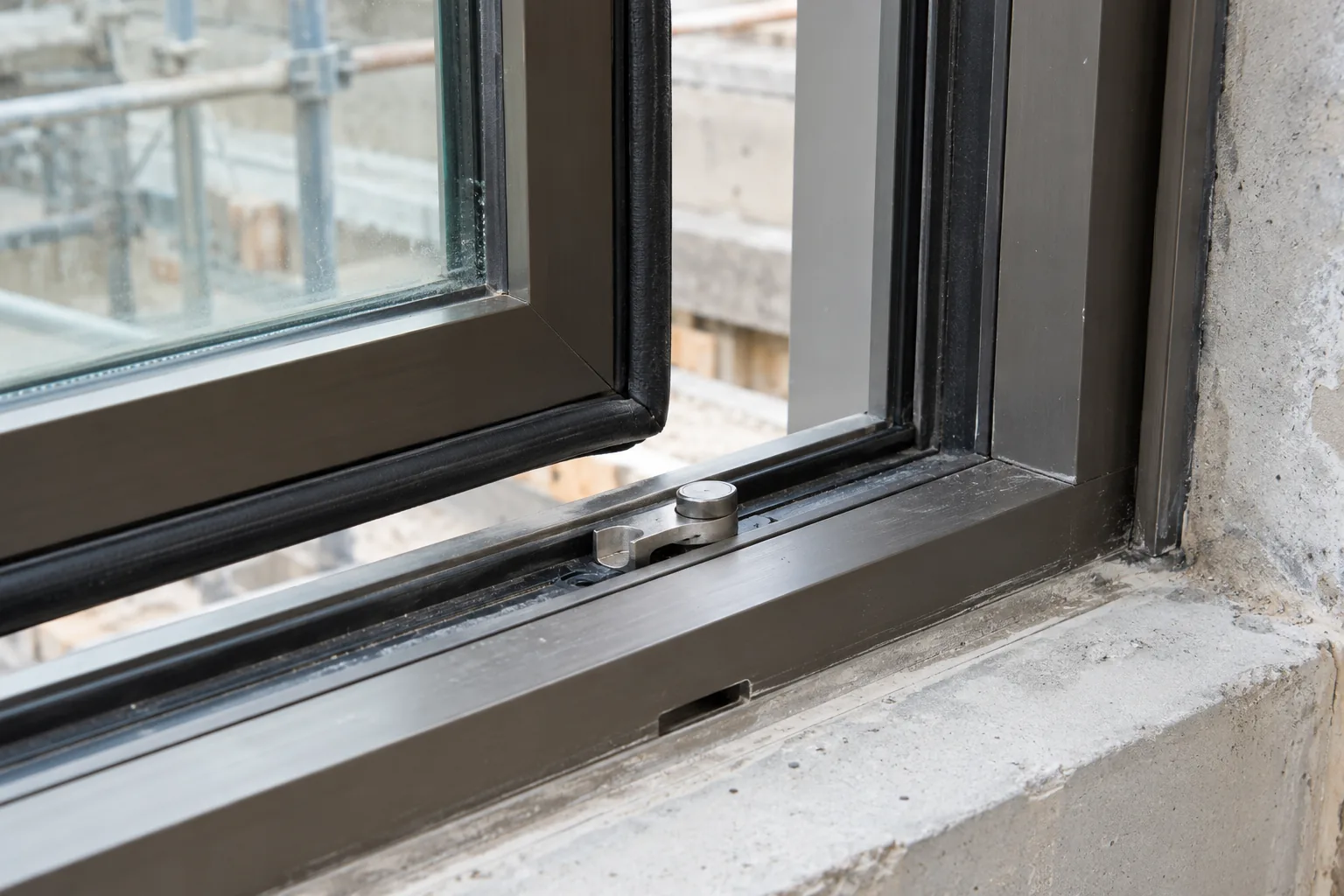
- Concurrent air leakage, operating force and latching force (§1.1.1, §4.1–4.3): Tight compression seals and heavy cam locks can reduce cavity sound transmission, but they also increase the force needed to slide or latch an operable sash. ASTM E1425 requires concurrent measurement of air leakage, operating force and latching force so that an operable window is tested in a realistic functional state rather than taped or clamped beyond normal operation.
- Perimeter isolation and mastic limits: As summarized in The Construction Specifier (January 2021), ASTM E1425 places the window into a filler wall whose sound transmission loss exceeds the specimen by at least 10 dB at every test frequency. The specimen rests on a closed-cell foam isolator pad with a perimeter gap no greater than 10 mm (393 mils) (up to 9.5 mm / 3/8 in. at the top and sides). Dense mastic seals the interior and exterior perimeter but may not overlap more than 6 to 12 mm (1/4 to 1/2 in.) of the frame so artificial damping is not added, and weep holes or slots are left uncovered.
- Temperature control for laminated interlayers: Because polyvinyl butyral (PVB) and acoustic interlayers are temperature-sensitive, The Construction Specifier notes that ASTM E1425 holds test room and specimen surface temperatures within 22 ± 2 °C (71.6 ± 3.6 °F) for laminated glass (versus 22 ± 5 °C / 71.6 ± 9 °F for non-temperature-sensitive specimens).
- Specimen size and edge restraint effects: ASTM E1332-22 §4.4 warns that low-frequency transmission loss measurements—and therefore OITC—are sensitive to test specimen size and edge restraints, especially on small modular specimens such as windows and doors. Confirm that the tested unit dimensions and operation type (fixed lite vs casement, awning, hopper or sliding sash) match the schedule.
Why must you read one-third-octave band data alongside single-number ratings?
Two glazing assemblies with identical STC ratings can differ by 3 to 5 points in OITC and by 6 dB or more in individual low-frequency bands because STC allows deficiencies above 125 Hz and ignores 80 and 100 Hz entirely.
Both Vitro Architectural Glass’s acoustic design guide and General Glass International’s September 2020 acoustical data tables illustrate how glass build-up shifts the gap between STC and OITC. The examples below are published center-of-glass laboratory figures from those two sources; they demonstrate how glass configuration affects frequency response, not what a framed window will achieve in a building.
Swipe sideways to see the other columns. The first column stays visible.
| Published glazing build-up (center-of-glass only) | Source document | Reported STC | Reported OITC | STC–OITC spread | Selected band TL from source table |
|---|---|---|---|---|---|
1/4" monolithic glass |
Vitro Architectural Glass | 31 | 29 | 2 points | Band table not listed in Vitro summary |
1/4" glass + 1/2" air + 1/4" glass IGU |
Vitro Architectural Glass / General Glass (Sep 2020) | 35 | 28 (Vitro) / 30 (OITC*, General Glass) |
5 to 7 points | General Glass: 27 dB at 100 Hz; 24 dB at 125 Hz; 37 dB at 2,000 Hz |
1/4" glass / 0.030" PVB / 1/4" laminated lite |
Vitro Architectural Glass / General Glass (Sep 2020) | 38 | 34 (OITC* in General Glass) |
4 points | General Glass: 25 dB at 100 Hz; 29 dB at 125 Hz; 41 dB at 2,000 Hz |
1-3/8" IGU: 1/4" glass + 3/4" air + 3/8" glass |
General Glass (Sep 2020) | 40 | 33 (OITC*) |
7 points | 30 dB at 100 Hz; 23 dB at 125 Hz; 28 dB at 200 Hz; 39 dB at 2,000 Hz |
1-1/8" laminated IGU: 1/4" glass + 1/2" air + 1/4" / 0.030" PVB / 1/8" |
General Glass (Sep 2020) | 40 | 30 (OITC*) |
10 points | 28 dB at 100 Hz; 17 dB at 125 Hz; 29 dB at 200 Hz; 40 dB at 2,000 Hz |
1-5/16" acoustic laminated IGU: 1/4" glass + 1/2" air + 1/4" / 0.100" StormGuard / 1/4" |
General Glass (Sep 2020) | 40 | 34 (OITC*) |
6 points | 28 dB at 100 Hz; 23 dB at 125 Hz; 28 dB at 200 Hz; 43 dB at 2,000 Hz |
Compare the last three rows from General Glass International’s September 2020 table. All three IGUs carry an identical STC 40, yet their reported OITC* values range from 30 to 34, and their transmission loss at 125 Hz drops from 23 dB (1-3/8" asymmetric monolithic IGU) down to 17 dB (1-1/8" laminated IGU with a thinner 1/8" ply)—a 6 dB difference at a key low-frequency band. Moreover, the printed columns in that September 2020 PDF run from 100 Hz to 5,000 Hz, omitting the 80 Hz column required by ASTM E1332-22 §4.2.
When you inspect a one-third-octave band table, check two physical regions noted in the ASTM scopes:
- Low-frequency mass-air-mass resonance (80–250 Hz): Insulating glass units can dip in transmission loss in the low bands depending on pane mass and airspace depth. Adding a thin laminated ply without sufficient mass or airspace can raise mid-frequency damping (boosting STC) while leaving a deep dip at 100–160 Hz that depresses OITC.
- High-frequency coincidence dip (typically around 2,000–2,500 Hz for glass): As explained in ASTM E966-18a §5.3.1, the coincidence effect occurs when the wavelength of sound projected along the pane matches the bending wave in the glass, creating a localized transparency dip (often near 2,500 Hz in diffuse-field tests of glass and drywall). Asymmetric pane thicknesses and damping interlayers are commonly used to stagger or damp that dip.
How do laboratory ratings differ from field facade measurements and flanking limits?
Laboratory ratings under ASTM E90 represent an upper bound where the window is the sole transmission path in a diffuse sound field; installed windows face directional outdoor sound waves, perimeter shims and wall flanking paths governed by ASTM E966.
According to ASTM E90-23 §5.1–5.2 (updated January 2024), laboratory chambers are isolated so that sound travels only through the test specimen under an approximately diffuse sound field. Section 5.2 states explicitly that because buildings contain flanking paths, laboratory sound ratings do not relate directly to sound isolation in buildings; they represent an upper limit to what would be measured in a field test.
When field testing is specified on a completed building, keep interior room-to-room standards separate from exterior facade standards:
- Interior partitions between rooms (ASTM E336-25a + ASTM E413-22): ASTM E336-25a (updated February 2026) measures Noise Reduction (
NR), Normalized Noise Reduction (NNR) and Apparent Transmission Loss (ATL) between enclosed interior rooms, which E413 converts into NIC, NNIC and ASTC. Those metrics depend on receiving-room absorption (unfurnished rooms typically yield lowerNRthan furnished rooms per E336-25a §5.3.1) and apply to interior space-dividing assemblies. - Exterior facades and windows (ASTM E966-18a + ASTM E1332-22): ASTM E966-18a (updated November 2018) covers field measurements of Outdoor-Indoor Noise Reduction (
OINR, rated via E1332 as OINIC) and angle-dependent outdoor-indoor transmission loss (OITL(θ)orAOITL(θ), rated via E1332 as FOITC(θ) or AOITC(θ)) using either calibrated loudspeakers or existing traffic/aircraft sources across six geometry methods.
ASTM E966-18a §5.3 highlights three reasons why field facade measurements will not match laboratory E90 window numbers:
- Incidence angle
θshifts the coincidence dip (§5.3.1): In the outdoors, sound arrives as a directional free field rather than a room-averaged diffuse field. Near grazing incidence (θclose to 90°, such as street traffic below an upper-floor window), the coincidence frequency drops significantly below the diffuse-field value; at steep angles (θof 30° or less), it shifts considerably above the diffuse-field frequency. - Directional surface intensity (§5.3.2): Free-field sound striking normal to a facade surface produces four times the intensity (a 6 dB term in E966 Equation 6) of diffuse-field sound at the same pressure level, while oblique angles scale by
cos(θ). E966 §5.3.3 therefore states that field guide methods should not be used as a substitute for laboratory testing in accordance with Test Method E90. - Flanking and multi-surface exposure (§5.5–5.6): Unsealed perimeter rough-opening gaps, curtain wall mullion cavities, spandrel junctions, trickle vents and adjacent wall cladding transmit sound around the window unit. E966 §5.5 notes that where auxiliary flanking checks cannot be satisfied, only
OINRand apparent lossAOITL(θ)are valid. Section 5.6 adds that when a room has multiple exterior surfaces, an unexposed wall or roof surface needs an OITC at least 10 points greater than the exposed window or facade element for its contribution to be negligible.
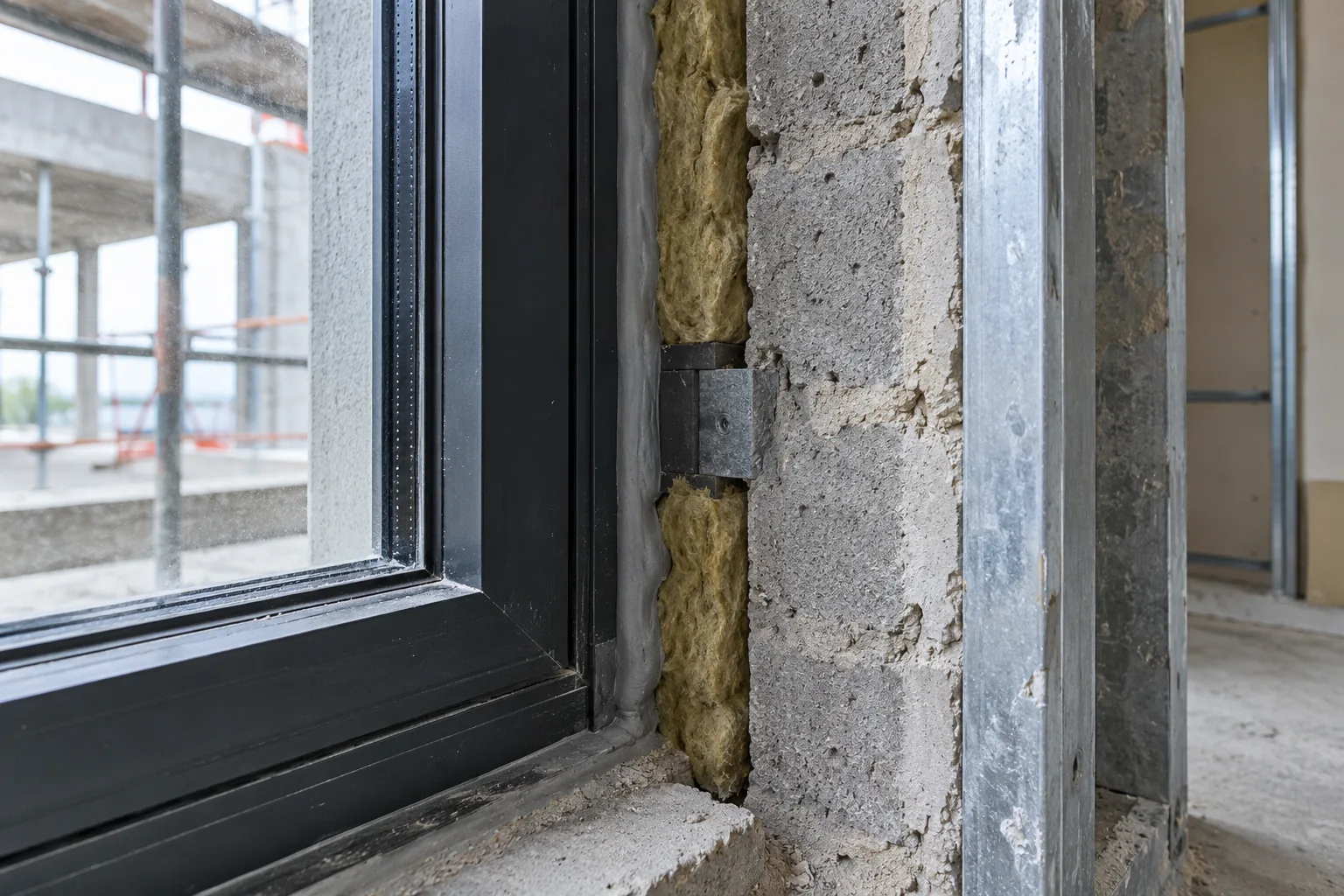
To coordinate the opaque wall assembly, drainage cavity and cladding transitions around the window opening, review our guides on types of facade systems, exterior wall cladding materials compared and ventilated vs direct-applied cladding.
Copy this window sound-rating evidence record
Use one row per candidate window submittal and attach the laboratory report and perimeter detail drawing. Do not infer full-window performance from a center-of-glass row, and leave unverified items marked Unknown — request report before selection.
Swipe sideways to see the other columns. The first column stays visible.
| Evidence field | Candidate A (worked mismatch example) | Candidate B (worked full-unit example) | Your project candidate: ____ |
|---|---|---|---|
| 1. Noise source & spectrum basis | Urban arterial road traffic; no site octave spectrum measured | Urban arterial road traffic; no site octave spectrum measured | Source type & whether site spectrum is measured: ____ |
| 2. Rating & test standard editions | ASTM E90 / E413 / E1332 cited on glass brochure; editions unstated | Lab report cites ASTM E90-23, ASTM E1425-14(2023), E413-22, E1332-22 | Cited test & classification editions: ____ |
| 3. Tested object (glass-only vs full window) | Center-of-glass IGU only (no frame, sash or hardware tested) | Complete operable casement window assembly in aluminum frame | Glass-only IGU or complete framed window: ____ |
| 4. Specimen build-up, operation & size | 1-1/8" IGU (1/4" glass + 1/2" air + 3/8" glass); size unstated |
Operable casement, 1200 × 1500 mm, thermally broken frame, laminated IGU |
Frame series, fixed/operable, glass build-up & tested size: ____ |
5. Single-number ratings (STC / OITC) |
STC 39 / OITC* 34 (brochure glass table) |
STC 37 / OITC 31 (accredited full-window test report) |
Reported STC: ____ / Reported OITC: ____ |
6. One-third-octave band TL (80–4,000 Hz) |
Printed columns start at 100 Hz; 80 Hz band missing | Full 18 bands (80–4,000 Hz) reported; 80 Hz = 21 dB, 125 Hz = 25 dB |
80 Hz: ____ 100 Hz: ____ 125 Hz: ____ 250 Hz: ____ 2,500 Hz: ____ |
| 7. Lab vs field measurement basis | Laboratory glass-only table | Laboratory diffuse-field upper limit (ASTM E90); no field OINIC/FOITC(θ) |
Lab (E90/E1425) or field (E966/E336) & report ID/date: ____ |
| 8. Installation, air/force & flanking unknowns | Hold: Frame series, sash seals, E1425 air/latching force and jamb detail unknown | E1425 air leakage and latching force reported; rough-opening shim/sealant detail and wall OITC margin (+10) still to verify | E1425 air/force data, perimeter joint detail & adjacent wall OITC: ____ |
How to read the worked comparison above: Candidate A appears 2 points higher in STC (39 vs 37) and 3 points higher in OITC (34 vs 31), but its numbers come from an unframed glass table that omits the 80 Hz band and all frame, gasket and weep-slot transmission paths. Candidate B’s lower numbers document a complete operable window tested with its seals and hardware. Until Candidate A supplies an ASTM E90 / E1425 full-assembly report for the actual frame and size—and until the designer verifies the perimeter rough-opening seal and adjacent wall OITC margin—the two options are not on an equal evidentiary basis.
When your project also needs exterior transition detailing after the window assembly is shortlisted, review how to combine facade materials or return to the facades and exterior design guide to coordinate glazing with wall drainage and cladding assemblies.
Method and limits: Sources were accessed between 11 October 2026 and 17 October 2026. This guide synthesizes the publicly available Scope and Significance and Use sections of ASTM E413-22, ASTM E1332-22, ASTM E966-18a, ASTM E90-23, ASTM E1425-14(2023) and ASTM E336-25a, alongside FGIA / AAMA 1801 testing summaries in The Construction Specifier (January 2021) and published center-of-glass tables from Vitro Architectural Glass and General Glass International (September 2020). Full paid ASTM standards and proprietary window manufacturer lab reports were not reviewed, and no independent acoustic testing was performed by this publication.
Sources
- ASTM E413-22: Classification for Rating Sound Insulation — public scope and significance — ASTM International Accessed October 17, 2026.
- ASTM E1332-22: Standard Classification for Rating Outdoor-Indoor Sound Attenuation — public scope and significance — ASTM International Accessed October 17, 2026.
- ASTM E966-18a: Standard Guide for Field Measurements of Airborne Sound Attenuation of Building Facades and Facade Elements — public scope and significance — ASTM International Accessed October 17, 2026.
- ASTM E90-23: Standard Test Method for Laboratory Measurement of Airborne Sound Transmission Loss of Building Partitions and Elements — public scope — ASTM International Accessed October 17, 2026.
- ASTM E1425-14(2023): Standard Practice for Determining the Acoustical Performance of Windows, Doors, Skylight, and Glazed Wall Systems — public scope — ASTM International Accessed October 17, 2026.
- ASTM E336-25a: Standard Test Method for Measurement of Airborne Sound Attenuation between Rooms in Buildings — public scope — ASTM International Accessed October 17, 2026.
- Strategies for reducing outdoor-indoor noise — January 2021 — The Construction Specifier Accessed October 17, 2026.
- Determining the Right Glass for the Right Acoustics — Vitro Architectural Glass Accessed October 17, 2026.
- Dual Pane, Triple Pane, Monolithic and Laminated Acoustical Data Tables — September 2020 — General Glass International Accessed October 11, 2026.