Which problem do you have?
Swipe sideways to see the other columns. The first column stays visible.
| Symptom | The problem | Where the fix lives |
|---|---|---|
| You hear the neighbours, the corridor, the next room | Blocking | Construction: mass, sealing, separation |
| Your own room is echoey, speech is unclear | Absorption | Finishes and furnishing |
| Voices carry too far in an open space | Absorption plus layout | Finishes and planning |
| A hard slap-back echo off one wall | Diffusion or targeted absorption | That specific surface |
| Impact noise from above | Structural | Floor construction, isolation |
If the answer is the first row, an absorption-only treatment does not establish a solution. That is a construction problem, and it generally means changing the wall rather than what is on it — which puts it on the interior architecture side of the line. See interior architecture vs interior design.
Three different problems
Most disappointing acoustic work comes from solving the wrong one.
Blocking — stopping sound getting from one space to another. Solved by mass, airtight sealing and structural separation. A gap around a door defeats a heavy wall, because sound follows air.
Absorbing — reducing reverberation and echo within a room. Solved by porous or resonant material with air behind it, distributed around the room.
Diffusing — scattering reflections so the room sounds even rather than echoey, without deadening it. Solved by irregular or shaped surfaces.
Absorption and transmission loss must be assessed separately. An assembly can combine an absorptive room face with sound-isolating construction, but its absorption rating does not establish its isolation performance.
For a shared bedroom wall, the comparison of soundproof wall panels and acoustic absorption separates NRC finish evidence from STC assembly evidence and identifies the junctions to review before finishing.
For material selection, the acoustic wall-panel type comparison separates four constructions and shows how to compare their laboratory reports without turning different specimens into a brand ranking.
Acoustic panels vs soundproofing
An acoustic wall panel is an absorber: a porous or resonant layer, usually behind a fabric, felt, perforated or slatted face, that turns part of the sound striking it into a small amount of heat. Soundproofing, in everyday use, means the other thing: stopping sound getting into or out of a room. Listings for “acoustic wall panels for soundproofing” blur the two, and the difference decides whether the purchase works.
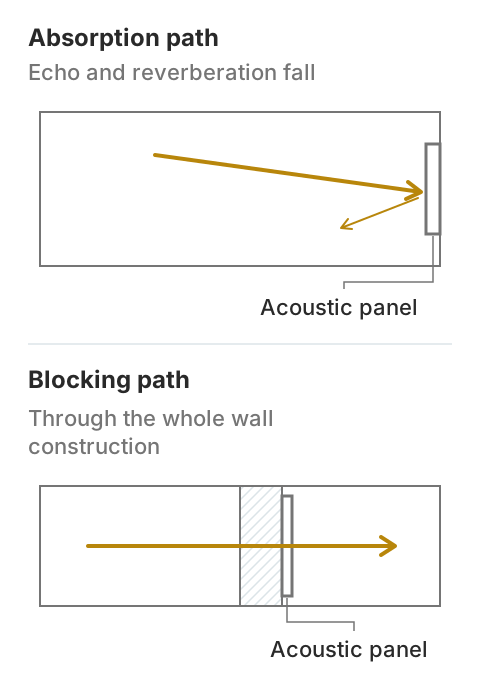
- Absorption path. Sound made inside the room hits the panel instead of a hard wall, so less of it reflects back into the room. Echo and reverberation fall; the noise reaching the neighbours barely changes.
- Blocking path. Sound from outside has to pass through the whole wall construction. A panel fixed to the room side adds little mass and no sealing or separation, so it does very little to this path.
The diagram above the article separates those two paths. A slatted or fabric face in a photograph does not show which path was tested.
The two are also measured differently. Absorption is tested on a sample of the material in a reverberation room; the airborne sound insulation of a wall is a separate measurement of the whole partition. A panel’s absorption figure says nothing about how well the wall behind it blocks sound. Acoustic foam panels follow the same rule: open-cell foam is a porous absorber, not a barrier.
How to read NRC and αw ratings
Both describe sound absorption, not how many decibels a wall stops. ASTM C423 and ISO 354 use reverberation-room measurements. ISO 354 explains that a suitably diffuse room approximates sound arriving from many directions; a result from that test is not a promise about one particular listening position.
NRC (ASTM C423). Average the absorption coefficients at 250, 500, 1,000 and 2,000 Hz, then round to the nearest 0.05. C423 retains NRC for comparison with older reports. It also defines SAA, using twelve one-third-octave bands from 200 to 2,500 Hz and rounding to 0.01. These are different summaries, so do not substitute one for the other.
αw (ISO 11654). This weighted rating uses a reference-curve procedure applied to practical absorption coefficients derived from ISO 354 data; it is not the NRC average. Annex B groups the resulting ratings as follows. These are classification thresholds, not test results for any product.
| ISO 11654 class | αw ratings covered |
|---|---|
| A | 0.90–1.00 |
| B | 0.80–0.85 |
| C | 0.60–0.75 |
| D | 0.30–0.55 |
| E | 0.15–0.25 |
| Not classified | 0.00–0.10 |
Ratings progress in 0.05 steps. An appended L, M or H indicates additional absorption above the shifted reference curve in low, middle or high frequency bands. It is a reason to inspect the full frequency curve, not an extra sound-isolation grade.
Mounting is part of the result
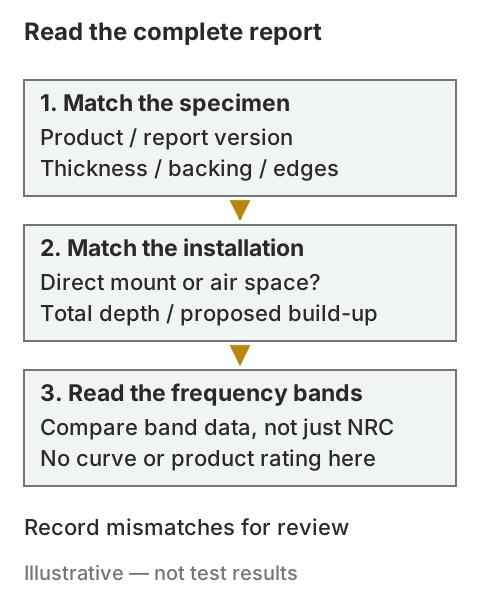
ASTM E795 defines Type A with the specimen directly against the test surface and Type E with an air space behind it. The E suffix measures from the exposed specimen face to the test surface: E-400 means 400 mm total depth, not necessarily a 400 mm clear air gap behind the absorber. ISO 11654 likewise requires construction depth to accompany results for specimens mounted over an air space.
Before comparing two reports, line up product identity, thickness, backing, mounting type, total construction depth and exposed edges. Compare the frequency-band curves as well as NRC or αw. If one report uses direct mounting and another a plenum, their single numbers alone do not show which panel would work better on your solid wall. Ask for data matching the proposed installation; this page makes no product-performance claim.
Why decorative panels often do nothing
Slatted or fluted appearance does not establish absorption. Sound can reflect from the face and backing; use measured data for the complete product and mounting rather than judging its relief.
An absorptive backing and the mounting arrangement can change the result. Two panels that look identical can perform very differently depending on their backing and their mounting depth.
So the questions to ask about any acoustic product are:
- What is the absorptive material, and how thick?
- What air gap is assumed behind it?
- What is the published performance, tested to which standard, in which mounting?
- How much area does the calculation assume is covered?
Without a report for the complete construction and mounting, acoustic performance remains unconfirmed. A resonant assembly may absorb without a porous backing; absence of that backing alone does not prove it is non-acoustic.
Coverage and position matter more than the panel
Two rules that decide outcomes more than product choice:
Coverage area. Acoustic effect scales with how much absorptive area exists relative to the room’s volume and its hard surfaces. The effect of one feature panel depends on its absorption area relative to the rest of the room.
Position. Select treatment locations against the sound source, occupied positions and room geometry. Opposite hard surfaces are candidates for reflection control, but treating one surface is not automatically ineffective. Record the problem and proposed coverage for an acoustician to assess.
Soft furnishing, carpet and occupants all contribute absorption too, which is why an empty room measured at handover sounds nothing like the same room in use.
Where finishes make things worse
Hard, flat, parallel surfaces are the acoustic problem, and several currently fashionable interior choices maximise them: full-height glazing facing a hard wall, polished concrete floors, seamless plaster, minimal soft furnishing. None are wrong, but together they produce rooms that are uncomfortable to talk in.
Texture alone does not fix this. A textured wall finish scatters sound slightly but absorbs almost none — see textured wall finishes for what relief does and does not do.
What to do
Use this editorial record alongside the symptom table; it is a brief for assessment, not a treatment quantity calculation.
| Record | Project entry |
|---|---|
| Room, use, dimensions and occupied positions | ____ |
| Noise source, symptom and candidate paths | ____ |
| Existing surfaces and proposed coverage | ____ |
| Product, report/version and test standard | ____ |
| Thickness, backing, mounting and total depth | ____ |
| Frequency-band data and unresolved conditions | ____ |
- Identify which of the three problems you actually have.
- If it is blocking, treat it as a construction question and stop looking at finishes.
- If it is absorption, get the room assessed — volume, surfaces, use — rather than picking a product first.
- Ask every product for its published data, the test standard and the assumed mounting.
- Check coverage against the calculation, not against how the sample looks.
- Confirm fire classification for the room’s occupancy, since many absorptive materials are organic.
For anything performance-critical — recording, teaching, healthcare, open-plan offices — this is work for a qualified acoustician. The interior wall finishes guide covers where finish selection sits alongside it, and wall panels vs plaster covers the substrate side of panel systems.
Frequently asked questions
Do acoustic panels actually work?
They can reduce reflected sound when the documented assembly and coverage suit the room. If the problem is noise entering from elsewhere, record the transmission paths separately; an absorption rating cannot demonstrate isolation. Use the room and report record below before selecting a finish.
How do you attach acoustic panels to the wall?
Follow the exact product's installation instructions and check that the proposed depth, backing and exposed edges match its absorption report. A report for an air-space mounting cannot establish the same result for direct mounting; use the mounting and frequency checklist below.
Sources
- ASTM C423-23: Standard Test Method for Sound Absorption and Sound Absorption Coefficients by the Reverberation Room Method — ASTM International Accessed October 6, 2026.
- ASTM E795-23: Standard Practices for Mounting Test Specimens During Sound Absorption Tests — ASTM International Accessed October 6, 2026.
- BS EN ISO 11654:1997 Acoustics. Sound absorbers for use in buildings. Rating of sound absorption — ISO (public preview via SIST) Accessed October 6, 2026.
- ISO 354:2003 — Measurement of sound absorption in a reverberation room (public preview) — ISO (public preview via SIST) Accessed October 6, 2026.