Quick check
- Build-up: retain the section, backing and attachment.
- Absorption: match frequency bands and mounting, not NRC alone.
- Fire: obtain evidence for the proposed finish and assembly.
- Care: match cleaning instructions to the room’s exposure.
- Scope: include preparation, edges and replacement in the comparison.
This comparison covers material selection, not treatment placement or room calculations. Start with what acoustic wall treatments actually do if the problem is sound travelling between rooms rather than reflections within one room.
What changes between the four constructions
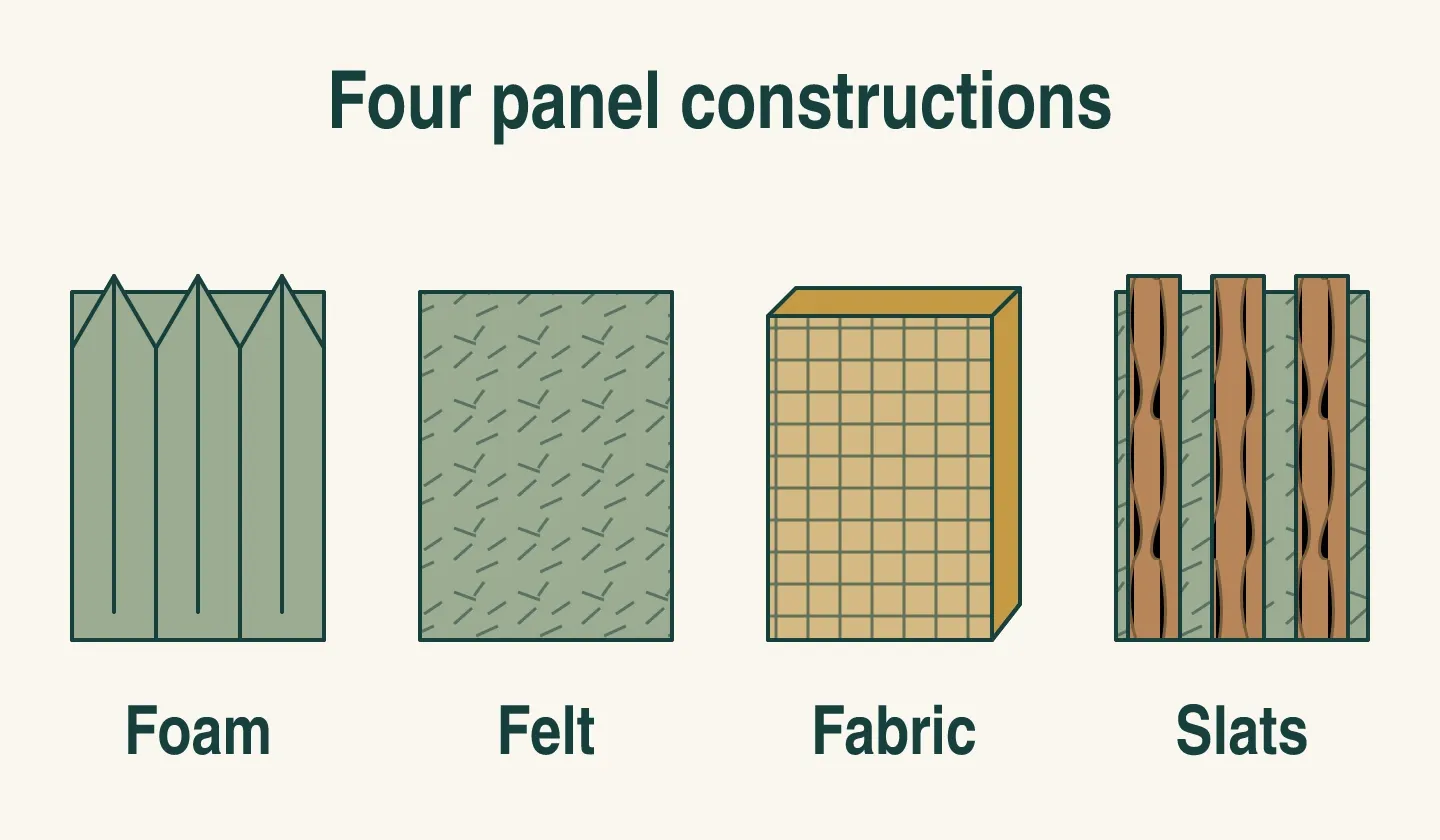
Look at the section before the colour chart. Foam usually exposes the absorbing body itself; felt is a fibrous sheet; a wrapped panel puts a finish around a porous core; a slat system places a harder face in front of backing. Those differences affect the questions to ask about thickness, edges and repair.
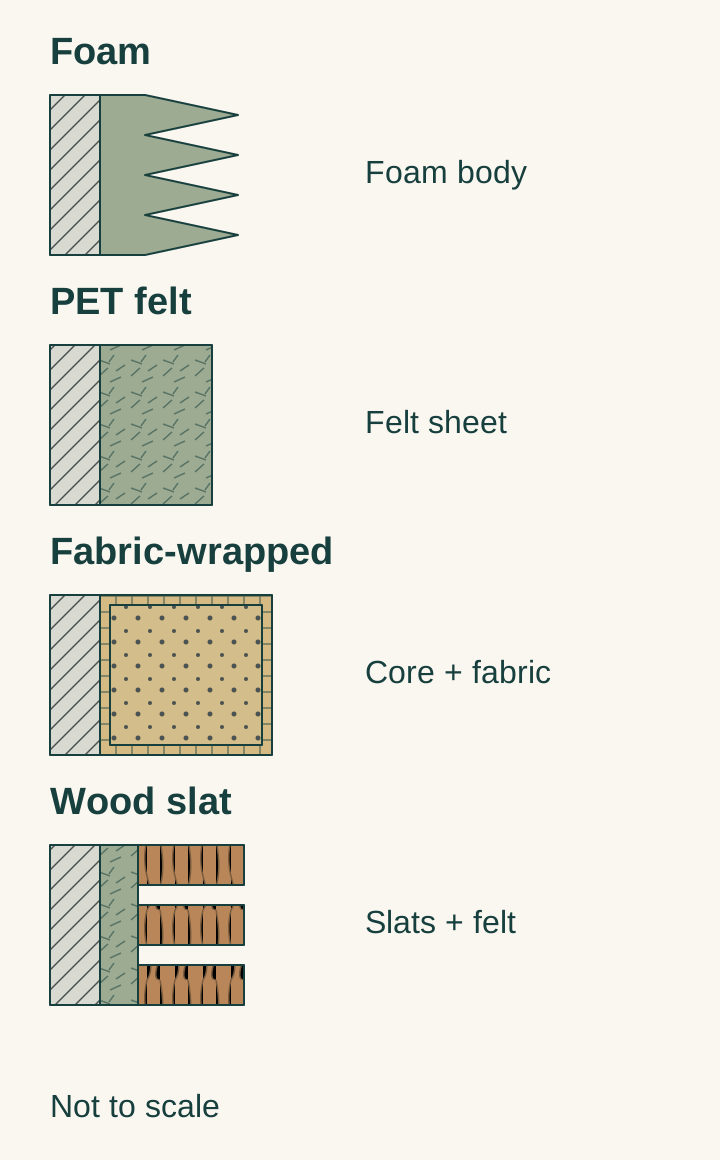
Acoustic foam panels. The Studiofoam example documented below is open-cell polyurethane with a wedge profile. Its nominal peak thickness is 50.8 mm, while its reported average thickness is 31.75 mm. A “two-inch” profiled product therefore does not contain the same geometry as a flat two-inch board. Check the actual section and keep packing foam or a visually similar untested material out of the substitution list.
PET felt panels and tiles. These present a fibre sheet as the finish. Product thickness, cutting and mounting remain separate variables. A decorative felt wall tile is not automatically a different acoustic material from a larger panel in the same range: compare the documented construction and the installed layout. Thin felt can suit an intricate visual pattern while still requiring careful attention to the lower-frequency results.
Fabric-wrapped panels. The cloth is the finish, while the core and mounting contribute to absorption. In the ProPanel example, the tested construction used a glass-fibre core with a Spinel fabric face. Ask for the named fabric, edge treatment and core, especially when a colour change also changes the fabric specification. A fabric selected only from an upholstery swatch may not describe the tested panel.
Wood-slat systems. In the ECOScapes example, wood-veneered MDF slats sit over PET backing. The slat width, spacing, backing and support are part of the product description. Solid timber slats attached to a wall without that build-up are not the same specimen. Coordinate their visual rhythm with the other interior wall finishes before treating them as an interchangeable acoustic sheet.
Takeaway: Compare the entire section, including the exposed face and backing, before comparing product names.
Four documented examples, with their conditions attached
The following manufacturer-hosted reports were checked in October 2026. They are separate historical laboratory tests, not a controlled trial between materials. All four examples use Type A mounting, but their thicknesses, geometry, specimen areas and test editions differ. The table is arranged by construction, not score.
Swipe sideways to see the other columns. The first column stays visible.
| Construction and documented specimen | Nominal or reported thickness | Test and date | Mounting in report | NRC |
|---|---|---|---|---|
| Auralex 2 in. Studiofoam Wedges | 50.8 mm nominal peak; 31.75 mm average | ASTM C423-17; 21 October 2019, RAL-A19-427 | A; perimeter edges exposed | 0.75 |
| Material LogIQ / ASI half-inch PET felt | 12.7 mm | ASTM C423-09; 4 February 2010, 3016010-2185-2 | A | 0.40 |
| Auralex B224 ProPanel with Spinel fabric | 50.8 mm nominal | ASTM C423-17; 4 May 2021, RAL-A21-302 | A; perimeter edges exposed | 1.05 |
| Primacoustic ECOScapes Slat Wall | About 21 mm overall, including 9.21 mm PET backing | ASTM C423-22; 6 April 2023, RAL-A23-083 | A; perimeter edges taped | 0.55 |
Sources: Studiofoam report, PET felt report, ProPanel report and Slat Wall report. These results apply to the submitted specimens. A recently downloaded report can still describe an old test; the download date does not update its specimen or standard edition.
An NRC above 1 is not a claim that the panel absorbs more than all the sound in your room. The laboratory result relates measured absorption to the specimen’s stated area; exposed edges and the test arrangement matter. Do not convert NRC into a percentage reduction in room noise. For a project comparison, ask for configurations close enough to answer the actual design question and retain the full frequency data.
Use a material-selection record to keep these conditions beside the chosen sample. If a supplier cannot identify the report’s model or build-up, leave the corresponding performance field blank until that connection is established.
Takeaway: These values demonstrate how to read a report, not which material wins.
Read frequency bands and mounting together
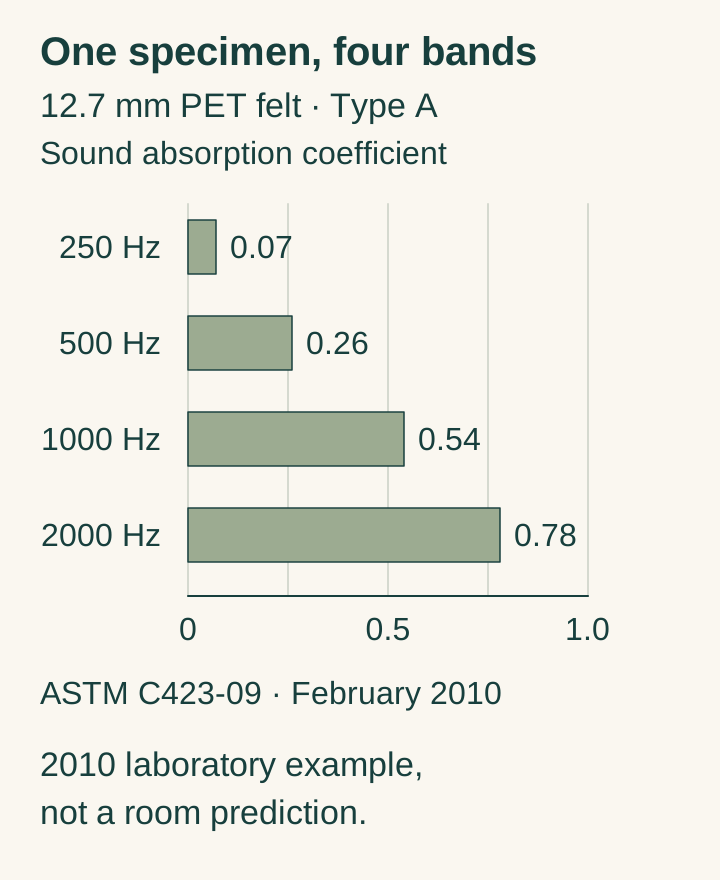
A thin product’s single-number rating can hide a large difference between its low and higher-frequency results. For the half-inch felt specimen above, the reported absorption coefficients are 0.07 at 250 Hz, 0.26 at 500 Hz, 0.54 at 1,000 Hz and 0.78 at 2,000 Hz. That is a useful within-specimen trend. It does not predict the result of applying the same area to a particular room.
For foam, felt and wrapped porous panels, inspect the lower-frequency rows rather than assuming a soft surface solves every frequency problem. For a slat system, also retain the face geometry and backing: the hard face does not disappear from the assembly simply because the catalog calls the system acoustic.
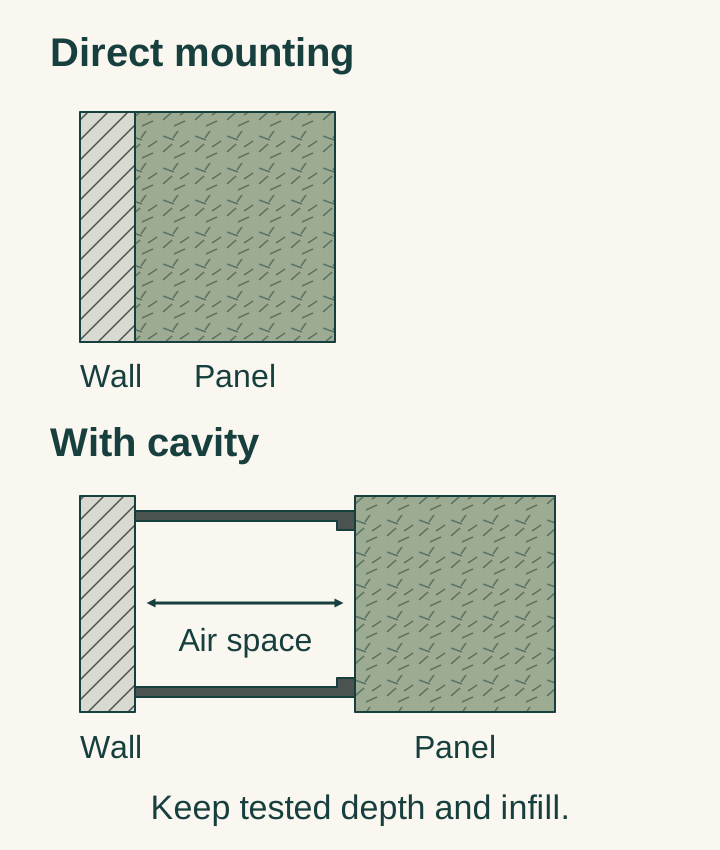
Type A describes direct placement against the test surface in these reports. Other mounting arrangements introduce different supports or cavities. An E-designated result, or a result with a different cavity or infill, should not be copied into a direct-mounted specification. Read the mounting description rather than guessing from a letter or a marketing installation photograph.
Takeaway: Match the frequency question and the mounting configuration before using a rating in a specification.
Fire documents must describe the right material
Fire evidence needs its own review. An absorption report does not supply a fire classification, and one test method cannot be silently substituted for another. For a commercial interior wall-material shortlist, identify the documents required for the actual location with the project team before approving a finish.
Swipe sideways to see the other columns. The first column stays visible.
| Example document reviewed | What it actually reports | What remains to confirm |
|---|---|---|
| Studiofoam, UL 94-18 HBF report, tested January 2021 | The submitted 2LBF foam met the horizontal burning acceptance criteria | Applicable wall-finish evidence; this is not an ASTM E84 Class A report |
| Half-inch white PET felt, ASTM E84-08a, September 2008 | Flame-spread index 15; smoke-developed index 200; manufacturer cover identifies Class A | Applicability to the proposed current colour, construction and installation |
| Spinel 3582-070 fabric, ASTM E84-03, April 2004 | Flame-spread index 0; smoke-developed index 50 for the tested fabric | Complete wrapped-panel assembly evidence, including core and attachment |
| ECOScapes Slat Wall, ASTM E84 report, April 2023 | Flame-spread index 0; smoke-developed index 40; Class A in the report | Match to the proposed finish and configuration; the fire specimen is separately described |
Sources: foam HBF report, felt E84 report, Spinel fabric report and Slat Wall E84 report.
The first and third rows deliberately leave assembly conclusions unresolved. A favourable component result is not evidence for every combination of fabric, adhesive, core and substrate. Nor does a surface-burning result establish noncombustibility or fire resistance of an entire wall. Keep the report, specimen description and manufacturer’s applicability confirmation together.
Common mistake: accepting “fire rated” without the test method, tested construction or intended location. The phrase alone does not identify the requirement being met.
Takeaway: Approve the required evidence for the specified build-up, not a general fire-rating adjective.
Cleaning and damage can change the shortlist
Choose a finish that the maintenance team can care for using the permitted method. Auralex’s cleaning instructions call for light vacuuming of both Studiofoam and ProPanels. For foam, they warn against harsh chemicals and saturation. For fabric panels, they warn against excessive rubbing and liquid that could affect the bond to the core. Those are product instructions, not universal rules for every foam or cloth.
Swipe sideways to see the other columns. The first column stays visible.
| Surface | Detail to inspect on a sample | Maintenance question to settle |
|---|---|---|
| Exposed foam profile | Peaks and cut edges where hands or equipment may touch | Can the specified cleaning method reach the profile without damaging it? |
| Felt sheet or tile | Cut edge, joint and surface after handling | Which cleaning agents and stain procedures are permitted for this finish? |
| Fabric-wrapped core | Corners, fabric tension and exposed edges | Can a damaged face be repaired, or must the complete panel be replaced? |
| Wood slats with felt backing | Slat edges, finish and recesses between slats | How are the face and recessed backing cleaned, and which parts are replaceable? |
These are sample-review questions, not comparative abrasion results. We have no common impact, staining or service-life test across the four examples. Do not turn a harder-looking face into a claim of longer life. A durability and maintenance assessment should reflect actual contact and cleaning, especially around chairs, carts and circulation routes.
Use material samples and mockups to check a corner, joint and realistic cleaning access. A small clean swatch cannot show how a long slatted wall will be maintained. If the location has unresolved dampness, settle the wall condition first; an acoustic finish is not a substitute for moisture-appropriate wall construction.
Takeaway: Require a workable cleaning and replacement method before accepting the visual finish.
Compare installed scope, not only panel area
Tiles, large sheets and fabric-track systems organise the work differently. Smaller modules create more joints and individual pieces to set out. Large-format panels need a delivery and handling plan, accurate openings and a replacement strategy. Site-stretched fabric introduces a track, core and fabric scope whose details must be coordinated together. These are cost components to compare, not a promise that one format is cheaper.
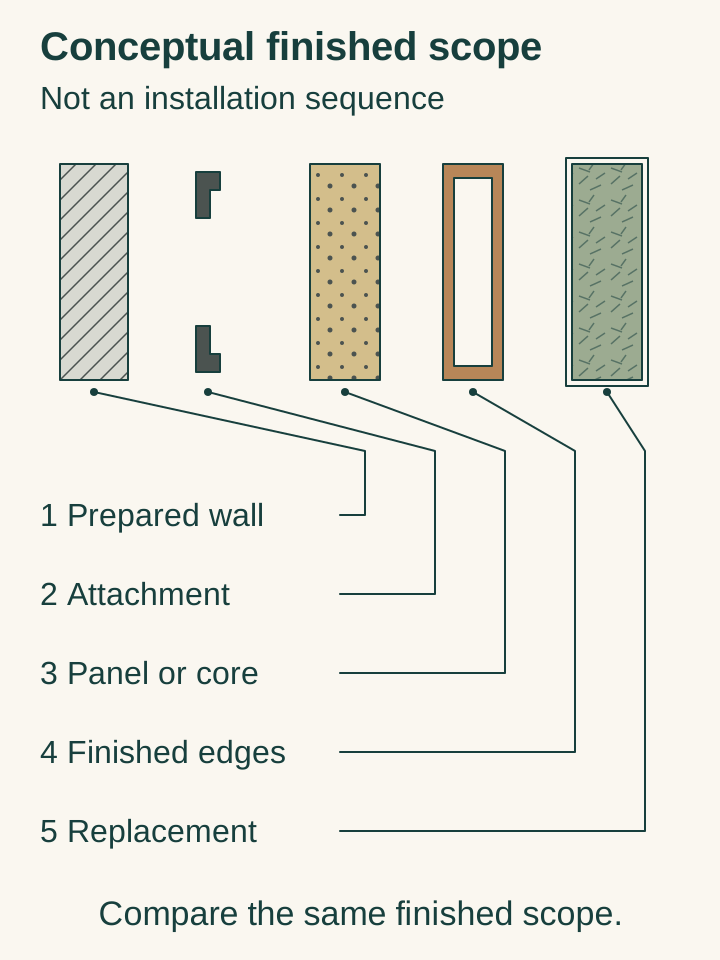
Ask each supplier to identify substrate preparation, attachment, panels or core, visible finish, edge trims, openings, delivery, installation and replacement stock. Record exclusions alongside quantities. A quote that includes only face area is not directly comparable with one covering finished corners and installation.
For curved walls, include the actual geometry in the request; the ability to cut a sheet does not establish a permissible bend radius. With peel-and-stick wall panels, treat the adhesive and existing surface as part of the decision, not as a reason to skip preparation. Coordinate the panel joints with the wider wall-texture composition before ordering full sheets that may be cut into small remnants.
Takeaway: Compare quotes at the same finished boundary, including edges, preparation and replacement.
Build the document request around the selected configuration
Put the proposed room use, finish, mounting and cleaning regime into the architectural brief. Then request a compact, traceable package rather than a folder of unrelated catalog pages.
- Product identity and section: model, thickness, face, backing, edge and proposed attachment.
- Acoustic report: laboratory, date, method edition, specimen area, mounting and frequency-band results.
- Fire evidence: the applicable report and a clear connection to the proposed assembly and location.
- Installation and maintenance instructions: permissible substrates, finish care and replacement procedure.
- Scope and samples: coordinated openings, edges, delivered finish sample and quotation exclusions.
Leave an unknown field empty or mark it “not supplied.” That makes the next question visible. Substituting a similar-looking finish should reopen the identity and evidence checks, not merely update the colour code.
Takeaway: A useful submittal connects one proposed construction to its reports, instructions and installed scope.
When this comparison does not apply
This guide does not calculate treatment area, predict reverberation time, design sound isolation or approve a regulated interior finish. Specialist rooms, critical listening spaces and locations with demanding hygiene or fire requirements need their own design criteria. A wall-panel report also does not approve a suspended ceiling installation or its fixings.
The examples were chosen because their reports were accessible, not because they represent every material or the current market. Some reports are old; confirm current applicability with the supplier. Missing classification or maintenance evidence is an unresolved selection item, not evidence that the product fails.
Takeaway: Use the comparison to improve a product enquiry; use project-specific evidence for the final specification.
Method and question sources
ASK Architectural Studio is an independent editorial publication. We reviewed the manufacturer-hosted reports linked above, including their specimen descriptions and mounting notes. We did not conduct acoustic, fire, cleaning or durability tests. The original diagrams explain construction and evidence boundaries; none depicts a measured installation.
The FAQ topics come from published customer-question pages: MPS on painting, Slatpanel on cutting, Easy Panels on heavy fixtures, Auralex on alternatives to wall adhesive, Acoufelt on custom printing and Auralex on cutting foam. Those questions establish practical concerns. Instructions remain product-specific and should not be transferred to a different panel without confirmation.
Frequently asked questions
Can I paint felt panels later to change their colour?
Ask the manufacturer before specifying that future change. MPS explicitly discourages painting its felt because coating the porous surface can reduce absorption. A factory colour or approved printed finish gives you a defined product to document; a site-applied paint creates a changed finish whose original report may no longer describe it. Keep the approved finish reference with the sample.
Can panels be cut around sockets without leaving rough edges?
Cutting methods differ between the felt backing and the slatted face. Slatpanel describes sawing its slats and cutting the felt with a sharp blade. Before ordering, ask for a sample cutout and an edge detail for the exact product. Coordinate electrical boxes with the responsible installer; a neat opening is not evidence that box access or the electrical installation is acceptable.
Can acoustic panels carry a television or a shelf?
Do not treat a decorative face as a structural fixing point. Easy Panels advises fitting heavy-fixture mounts before its panels, then cutting the finish around them. Have the support designed for the underlying wall and the actual load. Record the clearance and access needed for the bracket rather than asking a panel supplier to approve an unspecified fixing through felt.
Is there a removable option for a rented room?
Auralex offers alternatives to adhesive attachment, but some of its methods still puncture the wall. Separate removable panels from damage-free removal in your request. Ask for the proposed fixing, the permission needed from the owner and the expected making-good work. A freestanding product may be worth considering where the wall cannot be altered, subject to its own stability instructions.
Can I order a printed image rather than a plain fabric or felt face?
Manufacturers including Acoufelt offer printing and custom cutting. Request a physical proof of the finished product, not just the artwork file, and ask which acoustic and fire documents cover that printed finish. Confirm image cropping across joints and replacement-panel availability before approving production. Print capability alone does not establish that every ink or coating has the same performance.
Can I cut foam tiles into a pattern myself?
Auralex publishes cutting advice for Studiofoam, so alteration is possible for that product. First settle the pattern on a spare piece and ask what happens to the exposed edge and attachment. Do not transfer a full-size specimen's measured absorption to an arbitrary set of small shapes. If a documented room performance is required, have the altered layout assessed rather than assuming the original rating applies unchanged.
Sources
- Studiofoam Wedges, RAL-A19-427,2019 — Auralex / Riverbank Acoustical Laboratories Accessed October 7, 2026.
- Half-inch PET felt, Type A,2010 — Material LogIQ / Stork Accessed October 7, 2026.
- B224 ProPanel Type A,2021 — Auralex / Riverbank Acoustical Laboratories Accessed October 7, 2026.
- ECOScapes Slat Wall Type A,2023 — Primacoustic / Riverbank Acoustical Laboratories Accessed October 7, 2026.
- Studiofoam UL94 HBF,2021 — Auralex / Southwest Research Institute Accessed October 7, 2026.
- Half-inch PET felt E84,2008 — Material LogIQ / Commercial Testing Company Accessed October 7, 2026.
- Spinel fabric E84,2004 — Auralex / Omega Point Laboratories Accessed October 7, 2026.
- ECOScapes Slat Wall E84,2023 — Primacoustic / SGS Accessed October 7, 2026.