The finish is not the waterproofing
Tile alone does not make a shower waterproof. Select the assembly before the decorative surface.
Ordinary moisture-resistant gypsum board is not a water-control layer; USG’s public WB2660 sheet excludes its moisture-resistant panel as a tile substrate in directly wetted showers. Georgia-Pacific’s public DensShield instructions describe a tile backer with a built-in barrier and specified joint and penetration treatment. Schluter’s public KERDI-BOARD installation instructions describe waterproof panels whose seams, corners and fasteners need the system’s sealing components. These are different routes; neither supports adding a separate membrane to every board as a universal rule.
These manufacturer documents concern their tile assemblies, not approval for microcement or plaster. Use the installation document matching the actual system and confirm local acceptance.
Three conditions, three specifications
They get bundled as “wet”, and they are not the same problem.
Swipe sideways to see the other columns. The first column stays visible.
| Condition | Where | Main risk | What governs |
|---|---|---|---|
| Wet — direct liquid water | Shower enclosure, bath surround | Water reaching the structure | Approved waterproof assembly, junction detailing |
| Splash — intermittent liquid | Basin backsplash, kitchen behind a sink, WC | Local saturation, staining | Impervious finish, sealed junctions |
| Humid — vapour, no direct water | Bathroom generally, utility, drying rooms | Condensation on cold surfaces, mould | Ventilation, insulation, vapour behaviour |
A finish appropriate for one is frequently wrong for another. Humid areas need a surface that does not support mould and can be wiped; wet areas need a system, not a surface.
What each finish family tolerates
Use this as a document check, not a family-wide approval.
Swipe sideways to see the other columns. The first column stays visible.
| Family | Wet / shower check | Splash / humidity check |
|---|---|---|
| Ceramic / porcelain tile | Approved substrate and waterproof assembly | Jointing and cleaning instructions |
| Microcement / polished plaster | Explicit manufacturer approval for the complete shower system | Confirm the specific exposure, finish and sealer regime |
| Natural stone | Stone suitability and compatible waterproof assembly | Absorption, staining and cleaning documents |
| Large-format panel | Documented shower system, joints and penetrations | Product exposure limits and edge details |
| Paint, timber, wallpaper or fabric | Do not assume shower suitability | Confirm product approval for the location |
For microcement or polished plaster, record the approved substrate, membrane or other waterproofing components, finish coats, junction details and maintenance regime, alongside the installation manual and version. Missing approval means suitability is unresolved.
Where wet areas actually fail
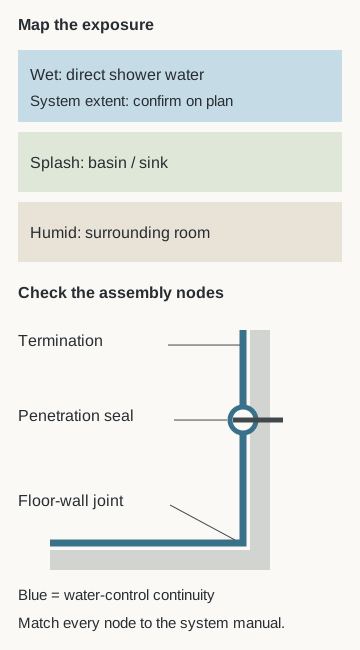
Check continuity at corners, floor-to-wall junctions, penetrations, movement joints and wet-zone terminations. The drawing below identifies review locations, not an installation prescription.
Humidity is a ventilation and insulation problem
In the humid case, no finish solves it. Condensation happens when moist air meets a surface below its dew point, so the answers are:
- Extraction sized correctly and actually used, ideally humidity-triggered
- Insulation so surfaces stay warmer than the dew point, particularly at thermal bridges — corners, external walls, window reveals
- Air movement, so moisture does not sit in unventilated corners
A mould-resistant paint applied to a cold, poorly ventilated wall delays the problem rather than solving it. See thermal mass vs insulation for why surface temperature is the controlling variable.
Deciding
Map exposures, then copy this node record onto the project drawing. For KERDI-BOARD, use the manufacturer’s Waterproofing section and linked shower handbook; for DensShield use its shower and tub installation details. Do not mix their instructions.
| Node / input | Record and verify |
|---|---|
| Exposure / extent | Wet, splash, humid; approved boundary and termination |
| Substrate / finish | Product, approval, manual version, maintenance |
| Corners / floor-wall | Matching band, seal or joint detail; drawing reference |
| Penetrations / fixings | Collar or seal detail; support and later fixings |
| Movement / threshold | System detail, continuity and inspection record |
| Humidity | Extraction and cold-surface checks |
For substrate demands across the wider finish set, see the interior wall finishes guide and feature wall materials compared; for why the fabric decisions close before the finish ones, see interior architecture vs interior design.
Frequently asked questions
Is tile waterproof?
Tile alone does not establish a waterproof assembly. Check the substrate, joints, penetrations and waterproofing specified for the shower. The water-control layer may be a membrane or part of an approved board system; its continuity matters more than the tile label.
Can I use microcement in a shower?
Only when the manufacturer explicitly approves the complete system for that shower exposure. Confirm the substrate, waterproofing components, finish, junction details and maintenance instructions together. A generic microcement label, sealer or approval for a splashback is insufficient.
What is the difference between moisture-resistant board and tanking?
Ordinary moisture-resistant board is a substrate, not waterproofing. Some tile backers include a water-control coating; other panels form part of an integrated waterproof assembly. Whether a separate membrane is required depends on the documented system, its installation details and local requirements.
Does a bathroom fan solve moisture problems?
Extraction helps control humidity when correctly sized and used, but cold surfaces and ventilation paths also need checking. It does not replace shower waterproofing. Review liquid-water protection and condensation control separately.
Sources
- DensShield Tile Backer — Installation Instructions — Georgia-Pacific, manufacturer documentation Accessed October 8, 2026.
- KERDI-BOARD — Waterproofing and Installation — Schluter-Systems, manufacturer documentation Accessed October 8, 2026.
- Moisture-resistant gypsum panel — WB2660 limitations — USG, manufacturer documentation Accessed October 8, 2026.