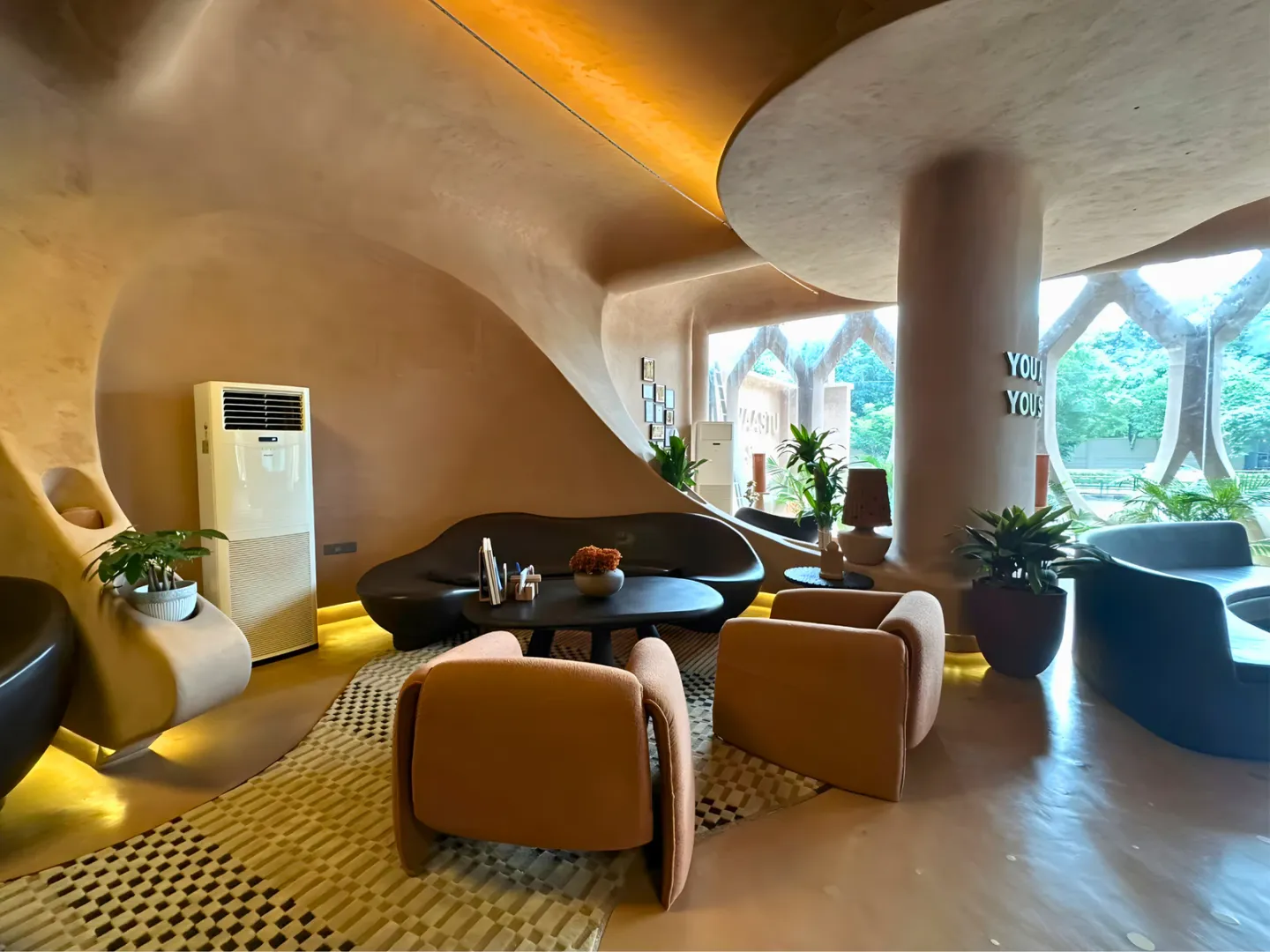
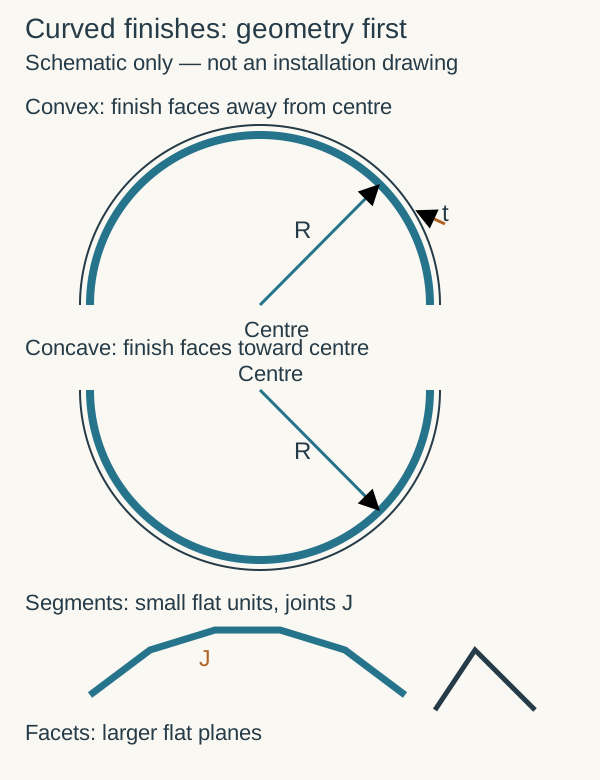
Radius first
Record radius and convex or concave direction from the finish side. Only a product expressly approved for bending should be compared with a published minimum radius. Keep other rigid sheets flat, or obtain a documented custom design.
Takeaway: Establish permission to bend before interpreting a radius table.
How each family handles a curve
Swipe sideways to see the other columns. The first column stays visible.
| Family | Mechanism | Radius tolerance | Watch |
|---|---|---|---|
| Wet-applied (plaster, microcement, render) | Takes the substrate’s shape | Confirm product and substrate limits | Substrate accuracy; cracking at movement |
| Mosaic and small tile | Segmentation in the joints | Check module, joints and radius | Joint width opens on the convex face |
| Medium tile | Segmentation | Project-specific | Lippage at the edges |
| Large-format tile or slab | None — must be flat or curved to order | Effectively flat | Curved slabs are made to order at cost |
| Thin flexible sheet | Bends within its rated radius | Product-specific | Confirm convex vs concave figures |
| Timber slat on curved backing | Segmentation between slats | Check slat width and joint layout | Slat width sets the achievable radius |
| Rigid panel, kerfed | Only if product documents permit | Unknown until confirmed | Verify support and effect on performance |
| Fabric and flexible coverings | Conforms within system limits | Product-specific | Support, tension and cleaning |
Family-wide radii are not given.
Takeaway: Check the specific document and current revision before choosing a forming method.
Confirm the complete substrate system
A thin finish does not establish a smooth backing. Review framing, support spacing, board layers, joints and forming method in the selected system documents. Two thin layers are an option only where that board and assembly permit them.
Public-document reading example, not a recommendation or our test: a manufacturer’s flexible-gypsum submittal WB2128, revision 4-20, identifies 1/4 in. (6.4 mm) panels and does not permit single-layer use. Its table gives a dry concave minimum radius of 20 in. (508 mm) with panels parallel to framing, or 30 in. (762 mm) perpendicular. Both rows use 6 in. (152 mm) framing centres, edge fasteners at 6 in. (152 mm) and field fasteners at 8 in. (203 mm). The manufacturer evaluated bending at 70°F (21°C), 50% relative humidity, and calls for a mockup. Check the current document before applying those conditions.
Takeaway: A radius without its thickness, orientation, support and forming conditions is incomplete.
Segmentation and faceting
Where the material will not bend, the curve is approximated:
Segmentation breaks the surface into small pieces, each flat, with the curve taken up in the joints. Works when the module is small relative to the radius. Joint width on a convex curve opens slightly at the face, which is either a detail or a defect depending on whether it was designed.
Faceting uses larger flat planes with visible angle changes. Whether it reads as a curve depends on facet width, viewing distance and lighting; compare project costs rather than assuming a saving. Grazing light along a faceted surface reveals every facet, which relates directly to how textured wall finishes behave under the same lighting.
What to confirm before specifying
| Check | Project record / evidence |
|---|---|
| Geometry | Radius / units / face measured / convex or concave: ___ |
| Product and thickness | Product ID / thickness / document revision: ___ |
| Orientation and forming | Direction to framing / dry, wet or heat method / permission: ___ |
| Manufacturer radius | Value and conditions / unknown / not permitted: ___ |
| Substrate and joints | Support centres / layers / fastening / segment joints: ___ |
| Fire and intended use | Applicable assembly evidence: ___ |
| Mockup result | Accept / revise / hold; photo / date: ___ |
Takeaway: Retain unknown and not-permitted results; use the sample and mockup guide to resolve the appearance decision.
When to stop trying
If the radius is below what any acceptable material will follow, the options are a made-to-order curved element, a faceted approximation, or changing the geometry. Do not force an unapproved bending method or infer a multilayer remedy from another product’s instructions.
For the wider finish shortlist see feature wall materials compared and the interior wall finishes guide.
Frequently asked questions
What is the minimum radius for a sheet material?
First confirm that the manufacturer permits bending. If so, use the limit for that product, thickness, direction and forming method. If no permission or limit is published, record unknown or not permitted rather than assigning a family-wide radius.
Can tile go on a curved wall?
Yes, by segmentation — the smaller the tile, the tighter the curve it will follow, because each piece stays flat and the curve is absorbed in the joints. Mosaic follows tight curves; large-format tile effectively does not.
What is kerfing?
Kerfing cuts relief grooves in a sheet. Use it only where the product and system documents permit it and address support and performance; it is not permission to modify any rigid board.
Is a faceted curve acceptable?
It can be, subject to the intended appearance and project cost comparison. Whether it reads as a curve depends on facet width relative to viewing distance and on the lighting — grazing light along a faceted surface reveals every facet. Test it at the real distance before committing.
Sources
- Building Envelope Design Guide — Whole Building Design Guide, National Institute of Building Sciences Accessed August 27, 2026.
- Flexible gypsum panel submittal WB2128, rev. 4-20, pp. 1-2 (manufacturer public document, not a recommendation) — USG Accessed October 8, 2026.