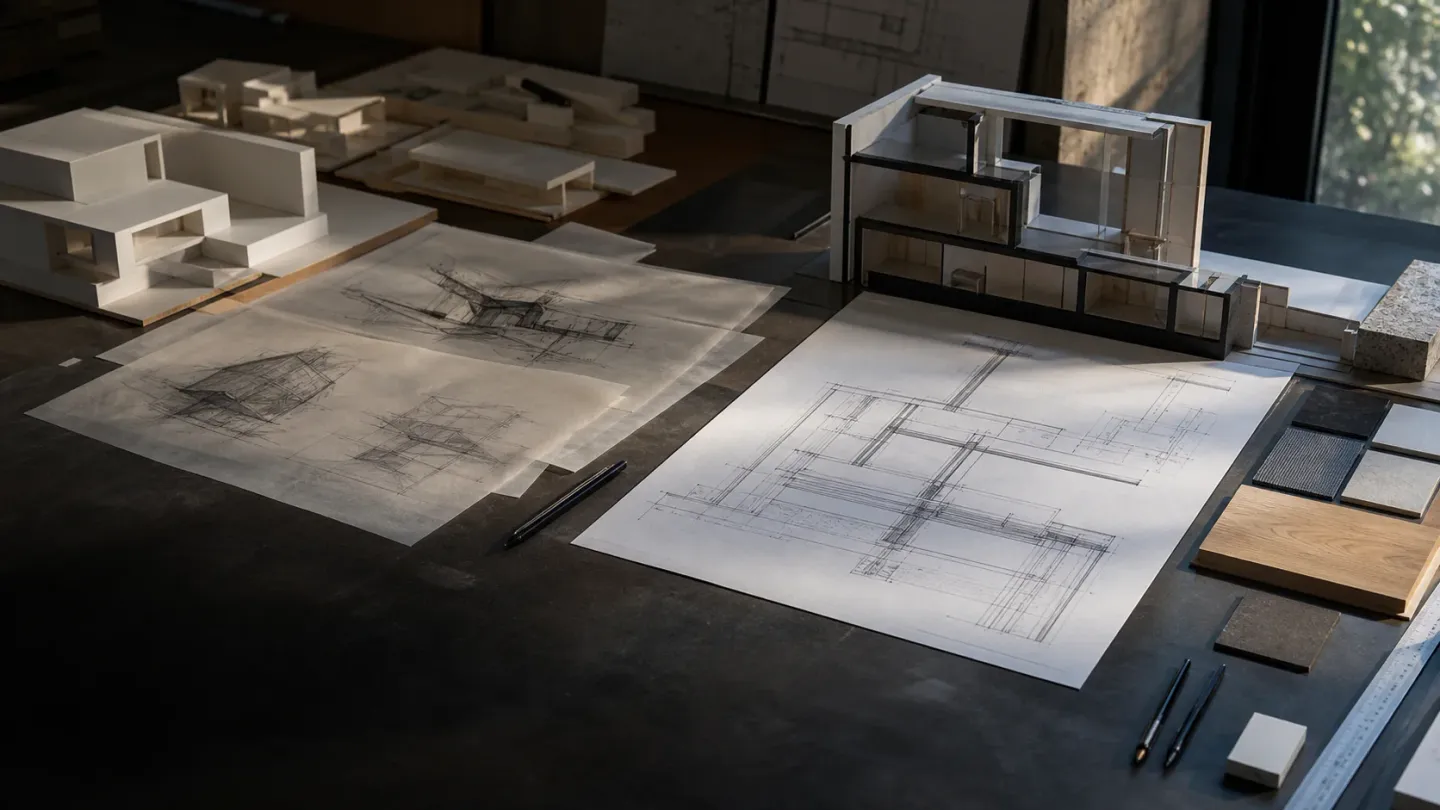
What is open and what closes
This is an editorial comparison, not an exact RIBA–AIA equivalence. AIA’s design-bid-build examples distinguish schematic and development drawings; actual deliverables are contractual. RIBA Stage 2 is Concept Design, Stage 3 Spatial Coordination and Stage 4 Technical Design.
Swipe sideways to see the other columns. The first column stays visible.
| Check | Schematic design | Design development |
|---|---|---|
| Arrangement / dimensions | Options and overall dimensions | Chosen layout and coordinated dimensions |
| Structure / services | Initial strategies | Systems and space requirements developed |
| Envelope / materials | Intent and options | Principal materials and build-up developed |
| Cost basis | Estimate against initial scope | Updated cost plan; record unresolved scope |
| Approvals | Check local information requirements | Check required submission scope and timing |
RIBA generally places planning submission at the end of Stage 3, with earlier gateways requiring defined information. That is not the same as building-regulation approval or every jurisdiction’s permit process. Neither framework makes all development drawings construction instructions.
Different jobs, not different levels of detail
The usual framing is that design development is “schematic design with more detail.” That is misleading, because the two stages are doing different kinds of work.
Schematic design compares. It generates arrangements and tests them against the brief, the site and the budget. Its study drawings support comparison before the chosen option is developed.
Design development commits. It takes the chosen arrangement and coordinates architecture with structure and services. Technical and construction-document work still follows as required by the appointment.
What coordination adds to the cost plan
More defined structure, envelope, services and materials can improve the basis of the estimate. Its remaining uncertainty depends on unresolved scope, market pricing and procurement timing.
An early price and an updated cost plan answer different questions. Ask which scope is priced, which allowances or exclusions remain, and who carries design and change risks. Coordination does not itself fix the final project cost.
The handover is where projects go wrong
Three recurring failures:
Treating a schematic render as a specification. Renders are produced before materials are fixed and details are indicative. If something in one matters to you, get it confirmed on a drawing or in the specification — see floor plan vs elevation vs section.
Deferring materials. Material choice has structural, fire and detailing consequences. Deferring it past design development means reopening coordinated work. The selection process belongs at this stage.
Skipping coordination to save time. Record clashes before dependent drawings or construction proceed. Their cost depends on the work affected, not an assumed hours-to-weeks ratio.
What to ask at each transition
Record the selected arrangement, estimate assumptions and coordination status at handover. Copy this editorial record; the filled row is fictional, not a project case.
Swipe sideways to see the other columns. The first column stays visible.
| Decision / status | Owner | Assumption / evidence | Change impact |
|---|---|---|---|
| Example: kitchen layout agreed; duct route open | Services designer | Confirm ceiling route on next coordinated drawing | Review ceiling, fee and programme before approval |
| ___ / agreed or open | ___ | Drawing / revision: ___ | Cost / approval / time: ___ |
Ask which structural and material decisions are coordinated, which are still open, and what the next stage actually delivers. Do not sign off open items as if they were resolved.
For where these tasks sit, see the stages of architectural design and the architectural design process guide. Before appointing anyone, work through the questions to ask.
Frequently asked questions
Can I get a fixed price after schematic design?
A price may be offered against defined scope and assumptions, but the stage name does not establish what it covers. Check unresolved design, allowances, exclusions, design responsibility and change provisions against the procurement route. Separate the estimate from the contractual price and total project budget.
How much detail should schematic drawings have?
Enough to compare options and test the brief, and no more. Over-resolving a schematic wastes effort on arrangements that will be discarded, and creates pressure to keep an option because time was spent on it.
What if the client changes their mind during design development?
Identify which coordinated decisions a change reopens, who revises them, and its fee, programme and approval effects. Record the change before authorising work. The consequences depend on the decision and appointment; they are not set by the stage label alone.
Do all projects have both stages?
Names and scope vary, and small projects may combine the activities. Confirm how options will be compared and the chosen design coordinated, rather than assuming both are included because a stage label appears in a proposal.
Sources
- RIBA Plan of Work 2020 Overview — Stages 2–4 and planning / procurement notes — Royal Institute of British Architects Accessed October 8, 2026.
- Defining the architect's basic services — design-bid-build examples — American Institute of Architects Accessed October 8, 2026.