If you assume the architect’s site visits mean someone is running the build, or that a construction manager signs every change, gaps in responsibility can surface as disputes over defects, cost and time. The two services answer different questions. This guide sets out which, using the AIA’s standard documents as a worked example, and gives you a responsibility record to fill from your own agreements.
Construction administration is the architect’s role during construction, as written in the appointment and the construction contract: periodic site visits, reports to the owner, written answers to questions, limited review of submittals, preparing change documents and certifying payment applications. Construction management is a separate professional service to the owner that manages schedule, cost, quality, safety, scope and function. In the AIA example the contractor, not the architect, controls construction methods and safety. On a real project, the signed agreements decide every allocation, so this page ends with a record you complete from those documents.
What is the difference between construction administration and construction management?
Construction administration (CA) is the architect administering the construction contract on the owner’s behalf, only as far as the contract documents allow. Professional construction management (CM) is an owner-facing management service that can run across the whole project. In the AIA example the contractor supervises and directs the work and controls construction methods and safety, while the architect observes and reports. Whether a construction manager may oversee or instruct the contractor depends on its own agreement, not on the service name.
Swipe sideways to see the other columns. The first column stays visible.
| Question | Construction administration (AIA A201–2017 example) | Professional construction management (CMAA description) | What to check on your project |
|---|---|---|---|
| Main purpose | Administer the construction contract and check that observed work is heading toward the contract documents | Manage schedule, cost, quality, safety, scope and function for the owner | Which purpose each signed agreement actually states |
| Who it serves | Owner’s representative during construction, with authority only as the contract documents provide | Owner; CMAA says the CM’s responsibility is to the owner | Who reports to whom, and who may instruct the contractor |
| Typical records | Field reports, written responses, submittal actions, change documents, payment certificates | Depends on the CM agreement: schedules, budgets, plans and reports | Which record each party produces, and who receives it |
| Site presence | Visits at intervals suited to the stage or as agreed; not exhaustive or continuous | Not fixed by the CMAA description | Agreed visit or attendance basis, written down |
| Where scope comes from | Owner–architect agreement (for example with B201 incorporated) and the general conditions | The CM agreement | Signed agreements, amendments and the general conditions in use |
The table compares an AIA example with a professional association’s description. Neither is your contract; the right-hand column is what you have to confirm.
Takeaway: Compare the two services by what each signed agreement allocates, not by the service names.
What does construction administration cover?
AIA’s B201–2017 is a scope-of-services document for design and construction contract administration. It has to be incorporated into an owner–architect agreement; it cannot stand alone. Construction is one of its five basic-service phases, and owner and architect may modify the scope. So the first check is whether CA is in the architect’s signed scope at all. The guide to what an architect does across the appointment covers the earlier phases.
In the A201–2017 general conditions, the architect’s construction-stage tasks include:
- Site visits and reports. Visits at intervals suited to the stage of construction, or as agreed with the owner, to become generally familiar with progress and quality. The architect then reports known deviations from the contract documents and the contractor’s latest schedule, and defects it has observed (§§4.2.2–4.2.3).
- Answers. Written responses to requests for information (RFIs) about the contract documents, within agreed time limits or otherwise with reasonable promptness (§4.2.14).
- Submittals. Review of shop drawings, product data and samples for a limited purpose (§4.2.7).
- Changes. Preparing Change Orders and Construction Change Directives (§4.2.8).
- Payment. Evaluating the contractor’s applications and certifying amounts due (§4.2.5).
- Closeout. Inspections to set substantial and final completion dates, and receiving warranties and related documents for the owner (§4.2.9).
These tasks sit after the design and documentation phases described in the stages of architectural design. If your agreement uses different forms or deletes any of these clauses, your allocation is different.
Takeaway: Confirm that construction administration is in the architect’s signed scope, and which clauses apply, before relying on any of these tasks.
Does site observation mean someone is controlling the work?
No. In the AIA example, the architect visits to become generally familiar with progress and quality and is not required to make exhaustive or continuous inspections. The contractor supervises and directs the work and alone controls construction means, methods, techniques, sequences and procedures (§3.3.1). Safety precautions and programs are also the contractor’s (§10.1).
Swipe sideways to see the other columns. The first column stays visible.
| Activity | Who does it in the AIA example | What it does not mean |
|---|---|---|
| Periodic site visit | Architect, at stage-appropriate or agreed intervals | That every element of the work was checked |
| Report to owner | Architect: known deviations and observed defects | That unreported work is free of defects |
| Supervising and directing work | Contractor | That the architect’s report is an instruction to trades |
| Safety precautions and programs | Contractor | That an observer has taken charge of site safety |
| Full-time site representation | Only if owner and architect agree to project representatives (§4.2.10) | That it is included in standard CA |
AIA’s G711 field report gives a useful shape for the record of a visit: a short record of periodic visits (or a daily log where a full-time representative has been agreed), observations that follow the reporting duties in the agreement, an “action required” field, attachments such as photographs, and the signature of the person who made the visit. You do not need that form. You do need to know who writes the record, how often, who receives it and who acts on it.
Common mistake: Reading “the architect visited and raised no issue” as “the work is right.” A visit report covers what was known or observed at that visit, within the agreed scope.
Takeaway: Treat a visit report as a record of what was seen at that visit; in the AIA example the contractor still controls methods and safety.
Where does a construction manager fit?
CMAA describes construction management as a professional service that gives the owner management of the project’s schedule, cost, quality, safety, scope and function, and says it suits any delivery method. It lists the architect/engineer as the designer and the general contractor as the party overseeing day-to-day operations and subcontractors. That is a description of a profession, not a contract. What a particular construction manager may do on your project comes from its signed agreement.
You will also see labels such as construction manager as agent, adviser or constructor. They describe different arrangements, and firms do not always use them the same way. No CM contract form was reviewed for this guide, so treat each label as a prompt to read the agreement, not as a definition. Before construction starts, ask:
- Which signed document appoints the construction manager, and which general conditions does it refer to?
- May the manager instruct the contractor directly, or only recommend to the owner?
- Does the manager sign change documents, or only prepare, process or recommend them?
- Who prepares the construction schedule, and who reports progress against it?
- Does the manager hold any construction contracts or employ trades?
- How do the architect’s reports and the manager’s reports reach the owner, and who reconciles them?
If the project is still at appointment stage, add these to your questions to ask before appointing an architect so construction-stage scope is settled early.
Takeaway: Read the construction manager’s agreement for what it may recommend, instruct and sign; the label alone does not tell you.
Who answers questions, reviews submittals and authorizes changes?
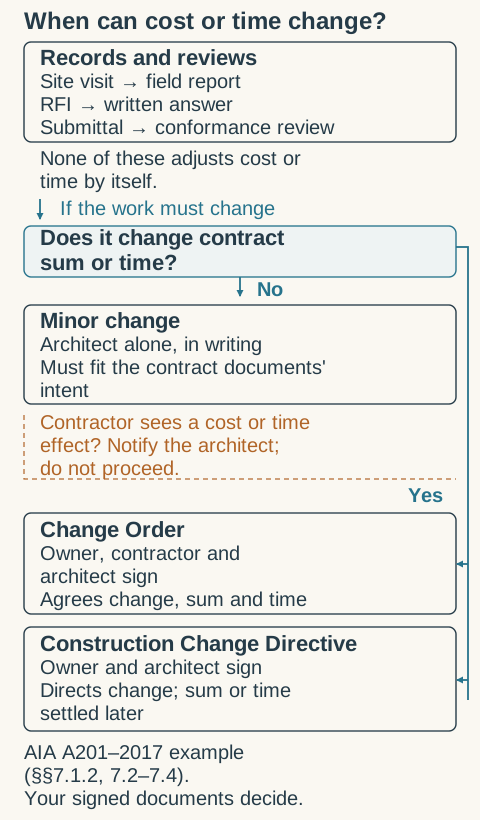
In the AIA example, the architect answers questions about the contract documents in writing, reviews submittals for conformance with the design concept, and prepares change documents. But an answer or a review does not change the contract sum or time on its own. That needs the agreed change instrument and the right signatures.
Requests for information (RFIs). A201 has the architect respond in writing within agreed limits or with reasonable promptness, and issue supplemental drawings or specifications if appropriate. It sets no universal number of days. When an RFI concerns how drawings relate, the guide to plans, elevations and sections helps identify which issued drawing answers the question.
Submittals. The contractor reviews, approves and submits shop drawings, product data and samples first. By submitting, it represents that it has checked field measurements and construction criteria (or will) and coordinated the information with the work (§§3.12.5–3.12.6). The architect then reviews only for conformance with the information given and the design concept. That review does not check dimensions or quantities, and it does not approve installation instructions, safety precautions or construction methods. Approval of one item is not approval of the assembly it belongs to (§4.2.7). For physical samples and mockups, see how material samples and mockups are reviewed.
Changes. The two main instruments in the AIA example differ in who signs:
Swipe sideways to see the other columns. The first column stays visible.
| Instrument (A201–2017) | Prepared by | Signed by | What it records |
|---|---|---|---|
| Change Order (§7.2.1) | Architect | Owner, contractor and architect | Agreement on the change and any adjustment to contract sum and time |
| Construction Change Directive (§7.3.1) | Architect | Owner and architect | A directed change before sum or time adjustment is agreed |
A201 also lets the architect alone order a minor change in writing, but only one that is consistent with the intent of the contract documents and involves no change to contract sum or time; if the contractor believes it would, it must notify the architect and not proceed (§§7.1.2, 7.4). Do not assume one signature rule covers every change. Find the clause in your own contract that names the instrument and its signatories.
Takeaway: Before acting on an answer or a review that affects cost or time, ask which change instrument applies and who must sign it.
Who handles payment, cost and schedules?
The architect in the AIA example certifies payment applications; it does not manage the project budget. The contractor prepares the construction schedule and the submittal schedule. A construction manager’s cost and schedule role, if any, comes from its agreement, and it can overlap with both.
- Payment certification. The architect evaluates the contractor’s applications and certifies the amounts due (§4.2.5). That is a check of the application, not an audit of the whole budget or a promise of final cost.
- Construction schedule. The contractor submits a schedule for the owner’s and architect’s information and revises it as conditions require (§3.10.1). The architect reports known deviations from it.
- Submittal schedule. The contractor submits it for the architect’s approval, coordinated with the construction schedule and allowing reasonable review time (§3.10.2).
- Construction manager. CMAA’s description includes developing a detailed schedule and budget and managing cost. Whether your manager prepares, reviews or only reports on these is set by its agreement.
When two parties both say they “manage the schedule,” write down which one prepares it, which one reviews it and which one reports to you.
Takeaway: A certified payment application is not a managed budget; name who prepares, reviews and reports on cost and schedule.
How do you fill in a construction responsibility record?
Use one row per construction-stage task, and fill each cell from a signed document, not from job titles. The first row shows the AIA A201–2017 allocation for site observation as a worked example. It is not your contract. Leave a cell blank, and note it in the last column, until you can point to a clause.
Swipe sideways to see the other columns. The first column stays visible.
| Task | Architect service | CM service | Contractor | Owner decision | Governing document or clause | Frequency or trigger | Unconfirmed gap |
|---|---|---|---|---|---|---|---|
| Example (A201–2017, not your contract): site observation and reports | Visits at intervals suited to the stage or as agreed; reports known deviations and observed defects | Not addressed by A201 | Supervises and directs the work; controls methods and safety | Agree the visit basis; receive reports | Owner–architect agreement; A201 §§4.2.2–4.2.3, 3.3.1 | Stage-appropriate or agreed interval | Any CM attendance; who acts on a reported defect |
| Site observation and field reports | |||||||
| Requests for information: tracking and written answers | |||||||
| Shop drawings, product data and samples | |||||||
| Proposed change: instrument and signatories | |||||||
| Payment applications, certification and cost reporting | |||||||
| Construction and submittal schedules | |||||||
| Follow-up of observed defects | |||||||
| Closeout: completion inspections, warranties, record drawings |
To complete it:
- Collect the signed documents. Owner–architect agreement and any scope exhibits, the CM agreement, the construction contract and its general conditions, and any amendments.
- Find the clause for each cell. Write the clause number in the governing-document column. If two documents give the same task to different parties, record both and flag the overlap.
- Separate the verbs. For each party, note whether it records, reviews, recommends, instructs or signs. A review on its own does not authorize a change to cost or time, even where it approves a submittal for its limited purpose.
- Set the trigger. Record the agreed visit interval, response period or event that starts the task. If none is agreed, write “not stated.”
- Name the owner decisions. Mark which items come back to you for a decision or signature.
- List the gaps. Every blank or conflicting cell becomes a question for the meeting described below.
B201’s instructions take the same approach for supplemental services. The parties name who provides each listed service, and the architect is not responsible for one unless designated. Closeout records follow the same logic. As-designed record drawings are the architect’s record. As-built drawings rely on the contractor’s mark-ups, and the architect is not responsible for their accuracy. So name who provides each. For how construction fits the overall sequence, return to the architectural design process guide.
Takeaway: Every filled cell needs a clause reference, and every blank cell is a question to settle with your project team.
When this comparison does not apply
This guide uses AIA forms as a US example and CMAA’s description of the profession. It does not interpret your contract. The comparison weakens or changes when:
- The project uses different standard forms, bespoke agreements or heavily edited AIA documents.
- Design-build, construction manager as constructor, or several prime contracts can change who holds the construction contract.
- The project is outside the US, or state or local law changes licensing, safety or contract rules.
- A dispute has already arisen. Contract interpretation and legal duties then need the appropriate professional, not a comparison table.
Our architectural information disclaimer sets out the limits of this educational guidance.
Takeaway: Where your forms, delivery method or jurisdiction differ, use the record as a list of questions, not as an answer.
Take the record to your project team
Bring the completed responsibility record to your architect, construction manager and contractor; verify against signed project agreements. Take the clause references and the list of gaps with you. Ask each party to confirm or correct its row, and keep the agreed version with the project documents.
Takeaway: Keep the agreed, corrected record with the project documents so every party works from the same allocation.
Method and sources
This is a comparison compiled from public documents: the AIA A201–2017 general conditions (preview edition), AIA’s published instructions for B201–2017 and G711–2018, and CMAA’s description of construction management, all accessed on 11 October 2026. Clause numbers are given so you can check the original; AIA wording is paraphrased, and the AIA forms are not reproduced. The responsibility record is an editorial tool, not an AIA or CMAA document. No project, contract review or site observation underlies this guide, and it makes no claim about fees, visit frequency or outcomes. See our editorial policy for how sources are selected and checked.
Frequently asked questions
Is construction administration the same as construction contract administration?
AIA's B201 title uses "construction contract administration" for the architect's construction-stage service, and many writers shorten it to "construction administration." Firms also use both phrases for services with different scopes, so read the scope in the signed appointment rather than relying on the phrase.
Is a construction manager the same as the general contractor?
Not necessarily. CMAA describes construction management as a professional service to the owner and lists the general contractor separately as the party running day-to-day operations and subcontractors. One firm can hold both roles on some projects, so check which agreement gives each role.
What should I check when a construction manager is described as an agent or adviser?
Ask for the signed agreement and find four things. What may the manager recommend, and what may it decide? Can it instruct the contractor? Does it sign or only process change documents? Who receives its reports? The label alone does not answer those questions.
What changes if the construction manager is also the constructor?
If the agreement makes the firm a constructor, it may hold construction contracts and control the work as well as manage the project. List each role separately in your record, with the document that gives it. Ask how cost, schedule and change information reaches the owner, and who reviews it independently.
Can an architect's construction services replace a construction manager's services?
They answer different needs. Construction administration covers the architect's design-related duties in the contract documents; professional construction management covers wider owner-facing management of schedule, cost and risk. Compare what each signed scope includes, task by task, before deciding whether one covers the other.
Can I compare construction administration and construction management fees by title alone?
No. Compare the tasks, visit or attendance basis, deliverables and authority each proposal includes. AIA's B201 instructions leave the compensation basis to the parties, so two proposals with the same title can cover different work. This page gives no fee figures.
Sources
- AIA Document A201-2017, General Conditions of the Contract for Construction (preview) — American Institute of Architects Accessed October 11, 2026.
- Instructions: B201-2017, Standard Form of Architect's Services: Design and Construction Contract Administration — American Institute of Architects Accessed October 11, 2026.
- Instructions: G711-2018, Architect's Field Report — American Institute of Architects Accessed October 11, 2026.
- What is Construction Management? — Construction Management Association of America Accessed October 11, 2026.